

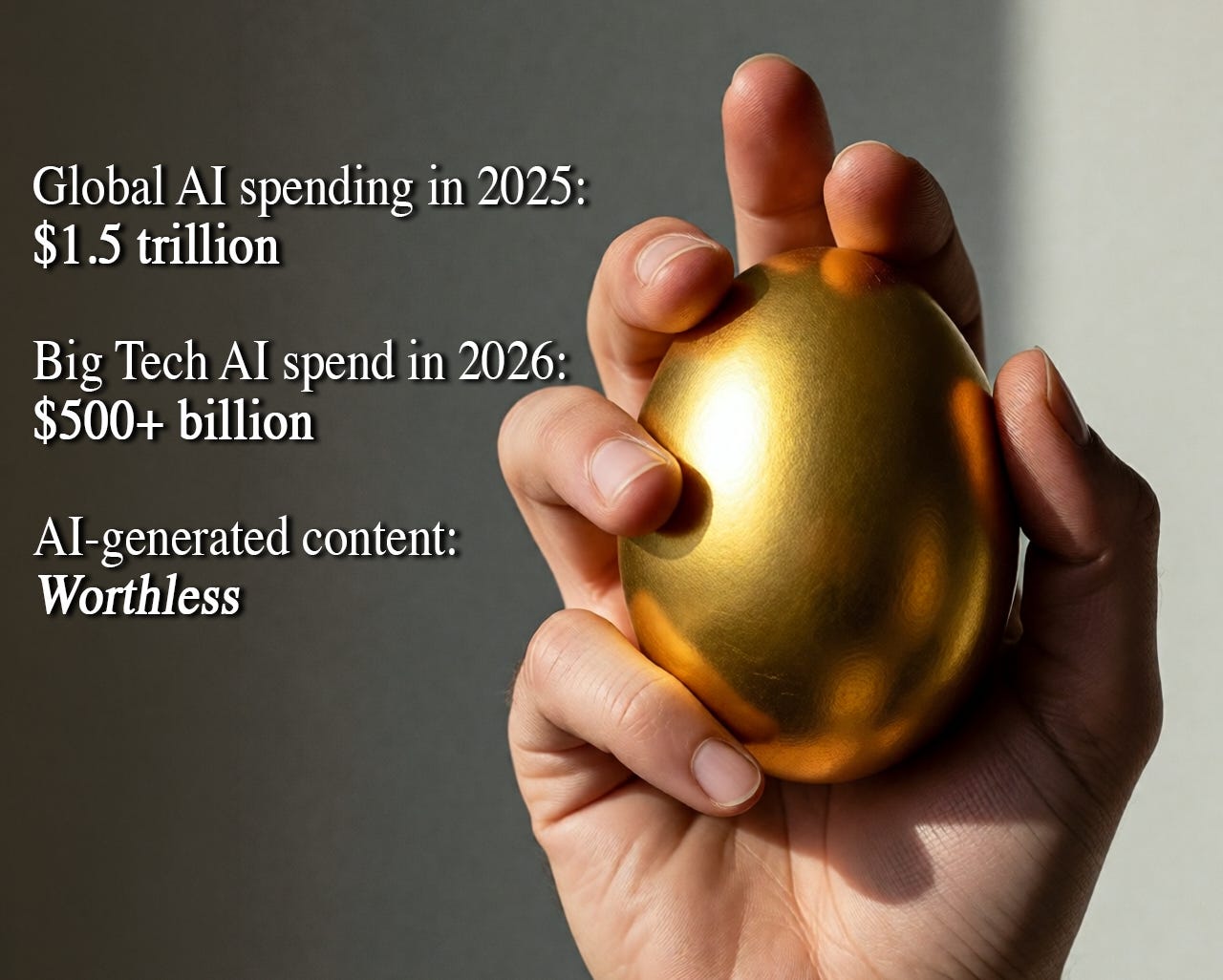
Silicon Valley built these fantastic machines that can seemingly pull any image, song, or film out of thin air, and corporate media has been eyeing that golden goose ever since. At this point, it isn’t a question of if they’ll try to sell those eggs. It’s when. They’ve already started easing them into the diet, with a Marvel Secret Invasion title sequence here, a Fallout recap there, and after-the-fact disclosures about AI accent tweaks and set extensions in The Brutalist. The public reaction has generally been... not great. Every move gets met with scrutiny, shrieking, and a fresh wave of think pieces.
Right now, monetizing AI content mostly happens at the individual level, and it often relies on a quiet kind of deception, convincing people that the work was created by hand with care, not generated via prompt. Take The Velvet Sundown, a Southern rock band that reached one million Spotify listeners before it was revealed they don’t actually exist. People were so focused on the scale of the bamboozle that they missed the real story: Spotify’s response.
They could’ve stood by artists and banned AI-generated music because it’s sucking up potential revenue from real, starving musicians. Instead, they added a checkbox for uploaders who would like to voluntarily identify their songs as machine-generated. That’s it. A voluntary checkbox seems to be the default concession for most platforms. As long as the slop doesn’t desecrate some sacred IP, they’re dead set on keeping AI content on the same playing field as regular content. They’ve sunk too much money into this venture not to try to normalize it.
The major platforms and studios are not investing billions into generative AI because they want to foster creativity. They’re investing because AI promises an infinitely cheap content supply. Skilled labor is expensive. Actors have unions. Writers strike. Artists act like, well, artists.
AI does none of that.
For Disney’s billion-dollar investment in OpenAI to make sense, they eventually have to get something back from the deal that they can actually sell, and from a media corporation’s perspective, the dream scenario is obvious: generate the next Black Keys instead of paying the real Black Keys. Generate prestige drama for pennies on the dollar and skip the expensive, unpredictable chaos of human production.
Then sell it to audiences at the same price.
There’s only one problem: it’s unclear whether consumers will agree to that proposition. I’ve yet to see AI-generated content openly advertised as such come with a price tag.
Look, I’m not one of those “AI is the great Satan” types. I love AI. I’m fascinated by how fast it’s evolving. I firmly believe the problem has always been how people use technology, not the technology itself.
But when it comes to AI-generated creative work, that stuff is worthless.
And I know that’s easy to say right now because we’re drowning in the toxic runoff of the Uncanny Valley. Today’s AI content is weird and hollow, but the improvement curve is insane. Just look at what people now call the “Will Smith Eating Spaghetti Test.” In only three years, we went from surreal nightmare fuel to merely off-putting. It won’t be long before it’s indistinguishable from commercial filmmaking.
But even if tomorrow’s models could generate Oscar-worthy cinematography that gives Emmanuel Lubezki a run for his money, audiences still won’t value that output the same way they value human work.
But What is “Real” Anyway?
It’s a morning ritual of mine to use ElevenLabs text-to-speech to listen to my manuscripts. It helps me step out of a writer’s mindset and just hear the story. Also, having Robo Michael Caine read Bobo the Garden Gnome is objectively hilarious:
The other day, my brother overheard me listening to the sequel to Welcome to the Deep Estate. He said, “It’s going to sound so much funnier with the real narrator.” He was right. Christopher Harbour is genuinely talented. But the phrasing stuck with me.
People instinctively frame the opposite of AI as real, and I don’t think that’s just because “Artificial” is in the name. Something deeper is happening. AI will always feel not real, no matter how real it gets.
If a machine can generate something in seconds that would take a human weeks, using skills that normally take a decade to master, our instinct isn’t to marvel at the machine’s superiority. We immediately discount what it made. It’s not real. It’s AI. It’s slop.
On some level, AI content sounds like a Zen riddle. How do you take a photo without ever touching a camera? What is the sound of a song recorded without a band? AI art has no existence before its generation. The model has no intention beyond following a prompt. It feels like everything is being conjured out of thin air.
Human creative work comes with a life outside of a digital file. You will never see Velvet Sundown in concert. You can’t point to a scene and say, “Tilly Noorwood actually broke her foot when she kicked that orc helmet.” Even if the AI actress could somehow give an Oscar-winning performance, who would accept her award?
The video model? The billionaire who funded it? Or the guy who hit generate?
Certainly not Tilly Noorwood. She’s just a JPEG with a PR team.
AI Will Never Have Its R. Mutt Moment
AI may be incredibly skilled, but skill and creativity are not the same thing. Generative models are trained to follow prompts, optimize outputs, and converge toward what pleases the user. They’re phenomenal at generating variations of things that already exist.
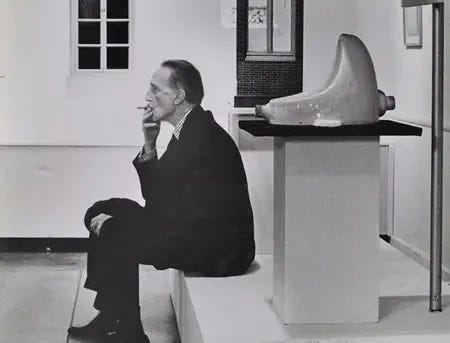
Humans tend to create by doing the opposite. They deviate and often follow the least optimal path. They take risks that might ruin their careers. So much of their end product is flawed, confusing, or unnecessary, until eventually something clicks. Suddenly, Duchamp’s poorly placed urinal with “R. Mutt” on the side becomes the mic-drop moment of the Dada movement.
People crave that kind of novelty. AI, fairly or unfairly, arrives with the stigma of offering only more of the same. That works in small, disposable bites on social media, and maybe for genre readers whose search histories already read like a prompt: “High quality, best-selling, steamy enemies-to-lovers romance between an elf and a centaur.”
The Slot Machine Problem
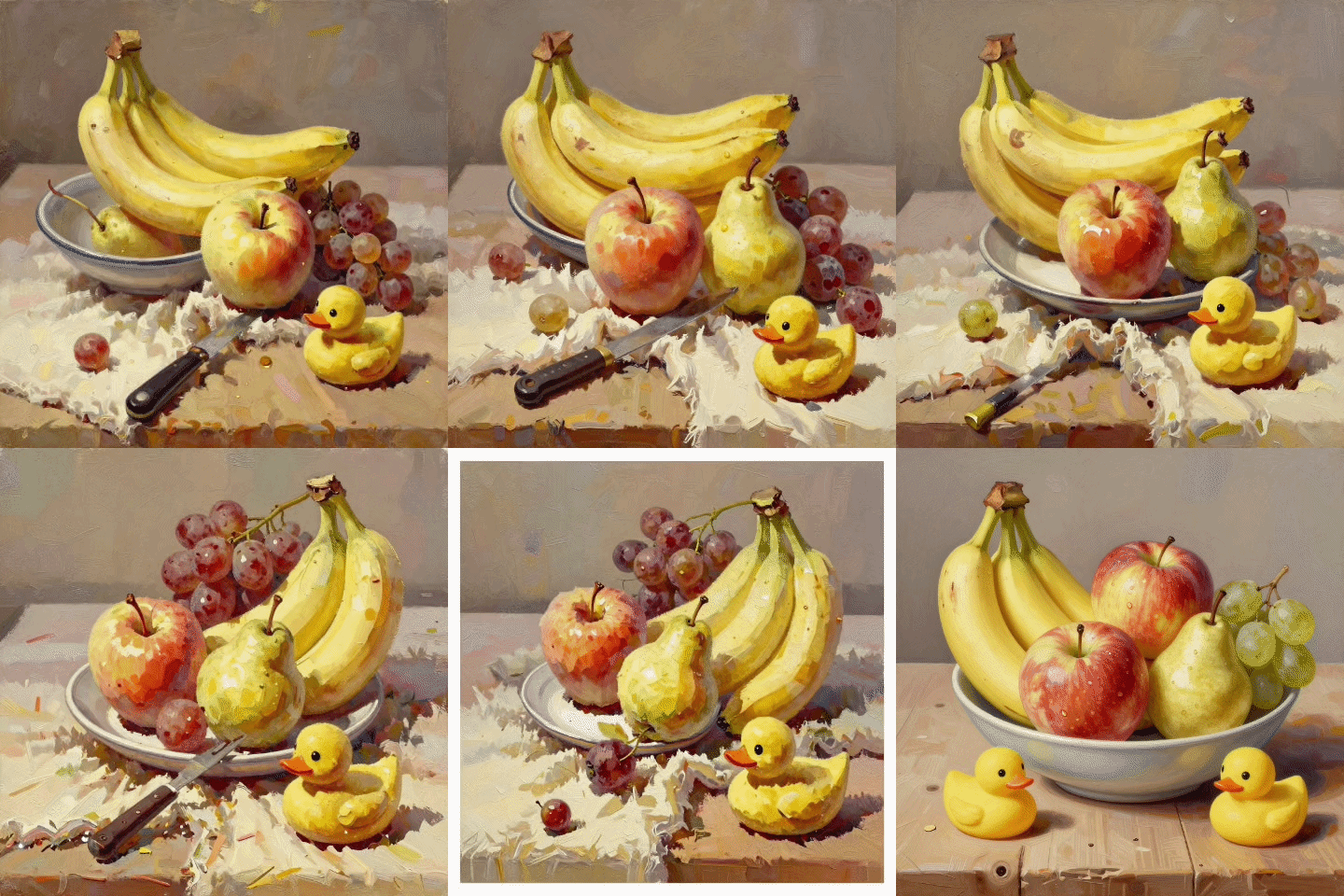
Suno, the AI music platform, is extraordinary. I love writing lyrics, prompting the style, hitting generate, and getting two fully produced songs thirty seconds later. If I don’t like them, I tweak the prompt and hit generate again. Two more songs appear. Do that twenty-five times, and suddenly you have fifty songs with fifty different melodies, performed by fifty different imaginary bands.
And I end up deleting forty-nine of them.
That disposable, whole-cloth generation undercuts the value of the finished product. Generative AI doesn’t really sketch out ideas. It’s more like a printer powered by a slot machine, and the human labor mostly comes down to pulling the lever and waiting for a jackpot.
At best, anyone trying to take credit for the output starts to look like a stage mom saying, “They wouldn’t even be famous if it weren’t for my guidance.”
It doesn’t matter how much cleanup or editing happens afterward. The default assumption is always that the machine did the heavy lifting. So when someone tries to sell generative media, the first reaction is simple: Why are we paying you for something the machine made?
The second reaction is worse. Why pay at all? I could make this at home.
The Generative Genie Is Out of the Bottle
Imagine having access to today’s MidJourney a decade ago. You could have built an enormously profitable career as an artist with minimal effort. You could have amassed huge followings, sold prints, landed commissions, and had studios lining up for concept work.
Now? Nobody cares. There is no meaningful skill barrier to high-quality work from AI, and that carries an inherent “I could make that” quality.
Things could’ve been very different if Silicon Valley had kept the genie in the bottle and only doled out wishes to the highest corporate bidders. Instead, they handed it out to anyone with a subscription. Even if they hadn’t, open-source models are only about six months behind in capability. And when everyone has a golden goose, that doesn’t mean everyone profits. It just means the gold market is about to collapse.
Studios like Disney and Netflix are clearly salivating over the idea that a ten-cent generation can replace a ten-million-dollar VFX shot. On paper, the math looks irresistible. Spend pennies, save millions. Somewhere on Buena Vista Blvd, an executive is absolutely convincing themselves that this translates directly into $9,999,999.90 more in profit, but it won’t math out that way in reality. Their logic assumes the two shots exist in the same marketplace. They don’t.
A ten-million-dollar spectacle shot is finite precisely because it costs ten million dollars to produce. That limitation creates scarcity. Scarcity creates anticipation. No one went to see Avatar 3 for the story. They went to watch James Cameron burn through half a billion dollars in the most visually stunning way possible.
The ten-cent imitation exists in a separate AI-saturated marketplace of its own making, where jaw-dropping visuals are no longer rare achievements but disposable spectacle that anyone with a subscription can generate. Its content that never quite transcends the suspension of disbelief because AI is still hard-coded in our minds as not real.
And when talent and skill are industrialized, value doesn’t disappear. It migrates. When nothing feels real, people begin to value authenticity. I wouldn’t even be surprised if Lars von Trier’s stripped-down Dogme 95 ethos came back around.1
If anything, the limitations of traditional filmmaking may only add to its appeal. People were drawn to Mad Max: Fury Road because it featured real cars, real stunts, and real explosions. I’m sure that same yearning for authentic spectacle will only intensify over time.
The real power of generative tools, at least right now, lies in personalization rather than monetization. I don’t listen to other people’s AI-generated music on Suno unless I’m hunting for prompt ideas, and they don’t listen to mine. The value lies in creating something for yourself, not in consuming strangers’ machine output.
The moment the technology allows it, I’ll absolutely try to generate long-form video just to see my own stories come to life. I’ve already experimented with a version of that through my AI radio play Some Stick Around, a feature-length ghost story designed to feel cinematic without turning on a screen.
And I give it away for free.
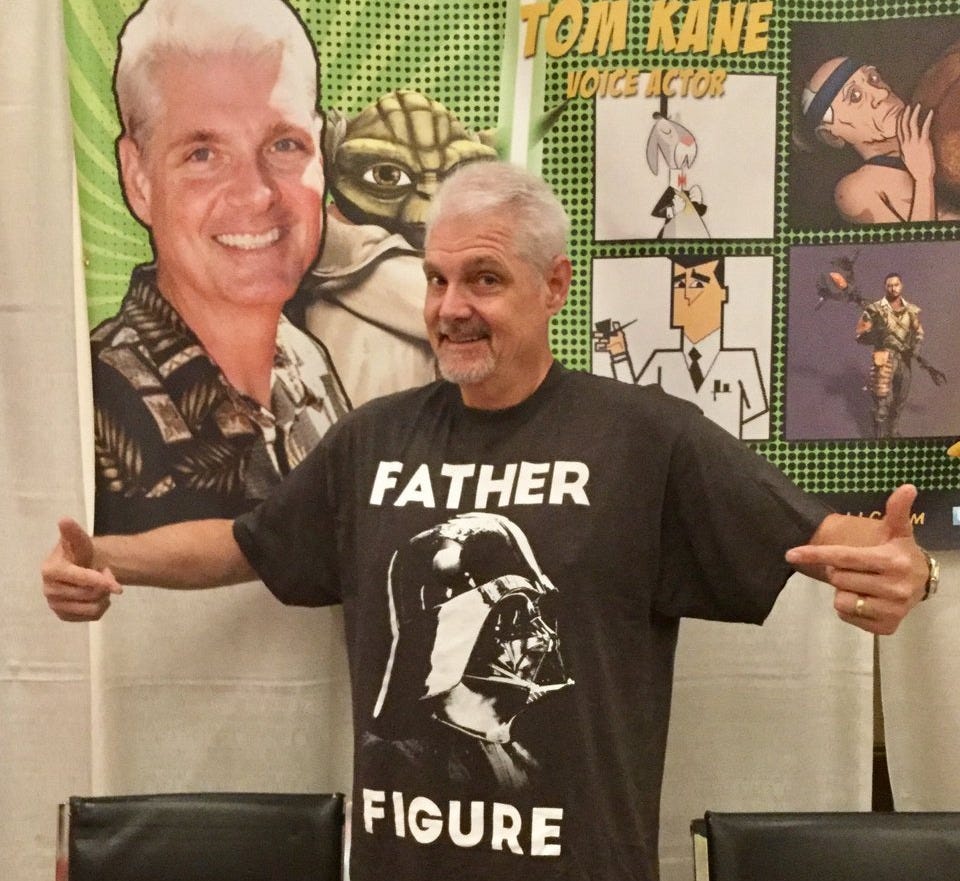
Not because I think it’s worthless, but because I don’t want to profit from the displacement of real voice actors like Christopher Harbour, or my father, Tom Kane, who spent decades building a career in that industry. I grew up watching countless faces light up with the realization that my dad voiced some of their favorite cartoons. You don’t get that when ElevenLabs is the norm.
Which brings me to the real cost of AI content. The one that actually matters.
The Human Cost
A viral tweet recently told a horror story about Amazon forcing thousands of engineers to document their jobs before replacing them with AI.
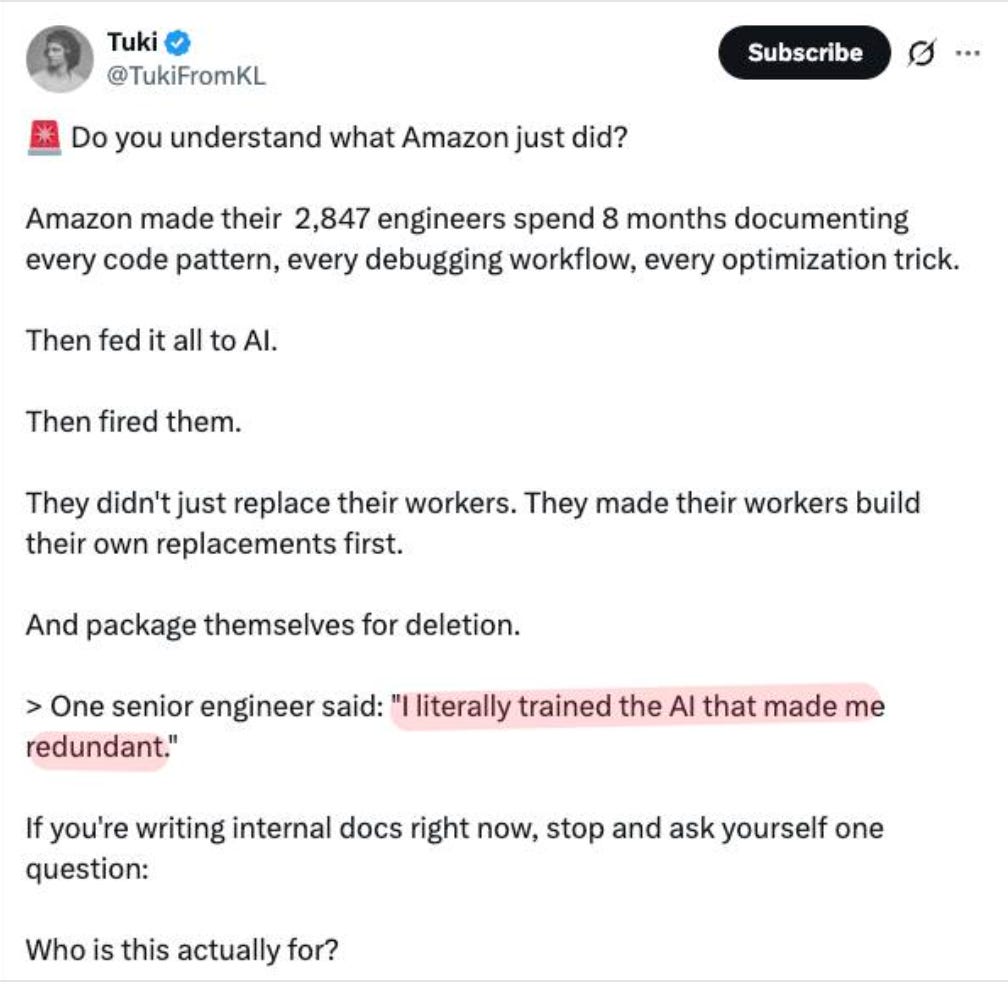
Is the post true? No. Corporations rarely gut departments in one dramatic event. They do it quietly. Positions go unfilled. Contracts aren’t renewed. Vendors lose clients. Layoffs happen at the edges.
But the story feels true. And that’s enough to fuel outrage.
We’re already seeing a justified social backlash against AI as everyone who isn’t a plumber begins to see the outline of an AI-fueled jobpocalypse. We can’t help but feel on edge every time yet another company rolls out an AI-forward PR release.
Sit through the credits of a Marvel film, and you’re confronted with thousands of names. Infinity War alone listed more than five thousand. Buying a ticket feels, however abstractly, like supporting that vast creative ecosystem. For that same reason, paying for AI media starts to feel like a tacit endorsement of all the people they didn’t hire, and audiences are becoming increasingly conscious of where that money is going.
And this is where reality begins to matter less than the vibes. Behind the Mickey Mouse mask is a faceless multinational corporation, and it’s naive to believe they won’t choose the most sociopathic option. Corporate efficiency and the almighty bottom line dictate that the Disney of the future will keep inching toward a Marvel movie where the credits are shorter than the post-credit scene.
Based on characters by
Stan Lee and Jack Kirby
Executive Producer
Kevin Feige
Prompted by
Rhett Reese and Paul Wernick
Written by
ChatGPT
Filmed, performed, directed, and rendered by
SeedDance 5.0
Post-FX cleanup by
The one guy still working at ILM
No animals were harmed in the making of this motion picture.
Whether or not that ends up being their actual intention is almost beside the point. It’s galling to imagine someone at Disney looking at the credits of Infinity War and wondering whether all those names could eventually be copy-pasted into a war memorial for the fallen VFX industry. As things stand now, every time a corporation releases AI-generated content, it feels like another step toward that future, and you can practically hear a barking laugh coming from some boardroom on a top floor.
That idea alone is enough to push people toward boycotting anything tainted by AI, and that rancor will quickly extend to anyone working on it. Imagine becoming the symbolic face of why so many people lost their livelihoods. Social media’s maximalist rhetoric will turn you into a scab crossing the picket line and betraying all of humanity. A quick paycheck won’t cover the cost of permanently damaging your career.
The pushback is going to come from a very big tent encompassing everyone who currently feels a bit of AI-based job insecurity, which is basically anyone using a computer. It will make your usual toxic fanbase look quaint by comparison.
My hope.
Unlike the Industrial Revolution, where factories turned artisans into factory workers, AI is both the factory and the factory worker. It doesn’t just mechanize labor. It mechanizes the labor force as well. That risks leaving the metaphorical artisans out in the cold, not because they stopped mattering, but because the system suddenly stopped needing them.
On the plus side, that also means the artisans will still exist, shivering and disgruntled as all hell.
Creators are stubborn. They don’t create because it’s efficient. They create because that’s what they do. Literature was arguably hit first by the AI blitzkrieg, and most writers didn’t pivot into prompt engineering or quietly pack it in. They did what writers have always done. They kept writing, neurotically rubbing at the fresh chip on their already chipped shoulders.
If anything, generative AI may end up doing something deeply ironic. By flooding the world with frictionless media, it could restore our appreciation for messy human things. Work with smeared eraser marks and fingerprints dried into the paint. Work that feels like someone risked embarrassment, failure, or obscurity just to make it exist.
Perhaps human-made art becomes the next luxury label. Fresh. Organic. Handcrafted. Human. Something people are willing to pay for, not necessarily because it is better, and not even because it is rarer, but because it feels real in a world increasingly filled with simulacra.
That may be the quiet future of creativity. Not total replacement. Not a clean victory for machines or humans. Just a bifurcation: infinite content on one side, finite intention on the other.
Maybe audiences will still consume AI media. Maybe they’ll enjoy it, and maybe they’ll even learn to pay for it. But when it comes time to spend real money, to signal real taste, to support something they believe actually came from another mind, they will reach for the human work.
If only to escape the slop.
Go to PetSmart and look for someone stocking shelves. They went to film school and know exactly what I’m talking about.