

You must feel it too. That little uncertain hitch as you take something in. A subconscious check we now all have, stopping you before you engage with anything new and asking, “Is this AI?” It’s become stranger danger’s second cousin, only instead of warning you about a van with no windows, it pipes up whenever you see a short story, an image, a song, comment, product review, news article, or weirdly sincere Facebook post from an uncle who usually types like he’s being hunted.
The most disturbing thing about the question “Is this AI?” is that it’s become almost interchangeable with “Is this real?”
On a certain level, that’s insane. There is no other way to describe it. AI has us walking around the internet like Russell Crowe in A Beautiful Mind, staring at everything and mumbling, “Is this real?” Yet the paranoia is justified. The fakery exists. The hallucinations and delusions are real. They’re just coming from the machines, not a chemical imbalance. I wouldn’t blame you for reading this far and deciding this piece is just three prompts in a trench coat. That’s the internet we’re swimming in.
As counterintuitive as it sounds, AI may be the reason behind the paranoia, but it’s not the problem we now have to face. The problem is what happens to us after we accept that realness is no longer guaranteed. Once you know someone in the room might be an impostor, you start side-eyeing everyone. Innocent or not, everyone becomes suspect.
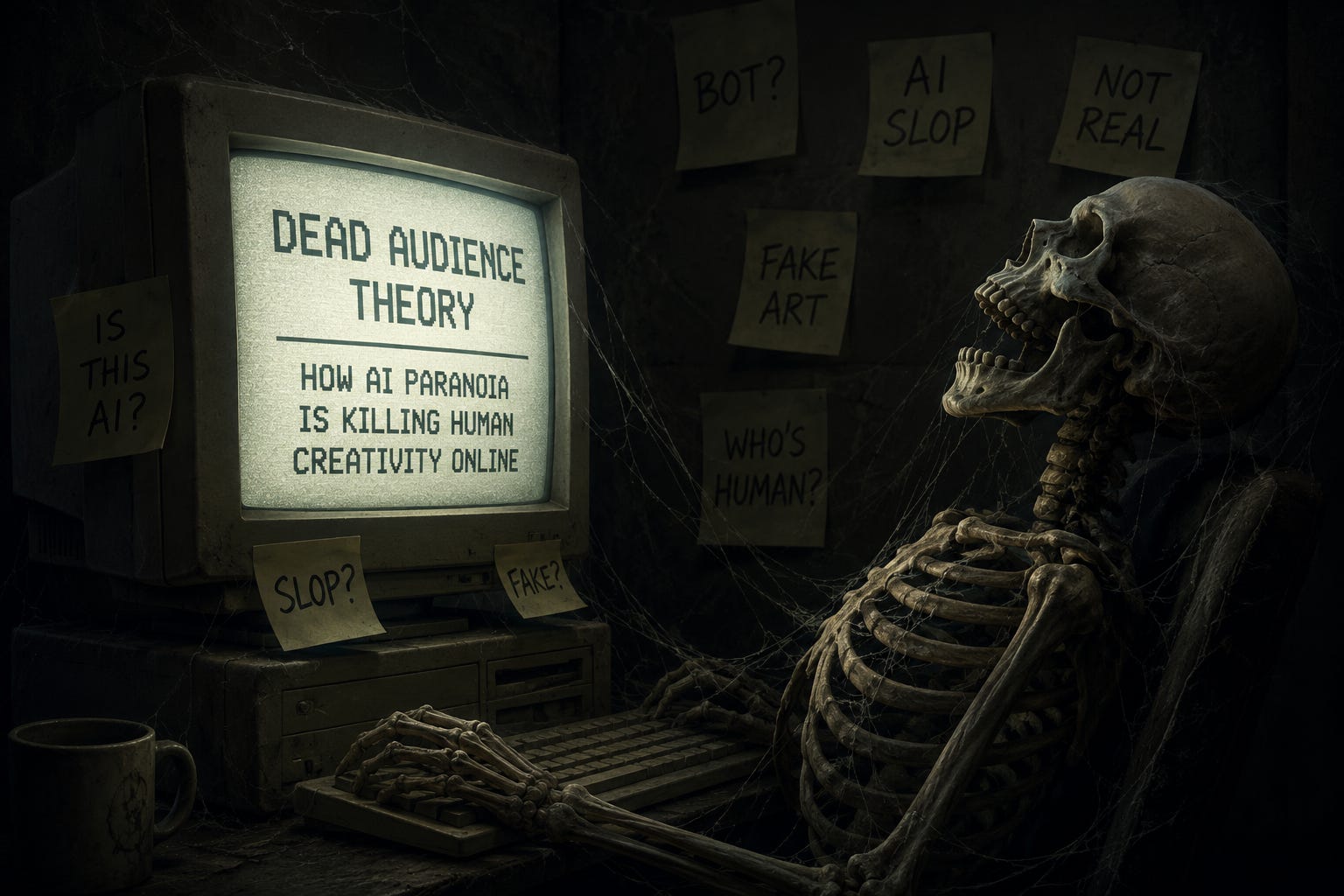
It’s what I call the Dead Audience Theory.
In 2026, Trinidad and Tobago author Jamir Nazir’s short story “The Serpent in the Grove” won the Caribbean regional award for the Commonwealth Short Story Prize.
Almost immediately, the internet began accusing the story of being AI-generated. People pointed to the usual tells. The story loves the rule of three. It has several “deep until you think about it” lines like “She had the kind of walking that made benches become men” and “the girl smiled like sunrise over a sink.” There’s also a third example I’m not going to give out of fear of being accused of the same crime.
Worse, the more people looked into it, the more it appeared that other regional winners might also be laundering slop. The AI cancer had clearly metastasized.
Except, not really.
After a month-long inquiry involving early drafts, timestamps, notes, and author interviews, the Commonwealth Foundation announced on June 22 that it was satisfied AI had not been used in the winning stories. Unfortunately, by then, most people had already moved on. Like most internet drama, the crowd wandered away without piecing it all together, absolutely convinced they understood the full picture because it was right there on the front of the puzzle box.
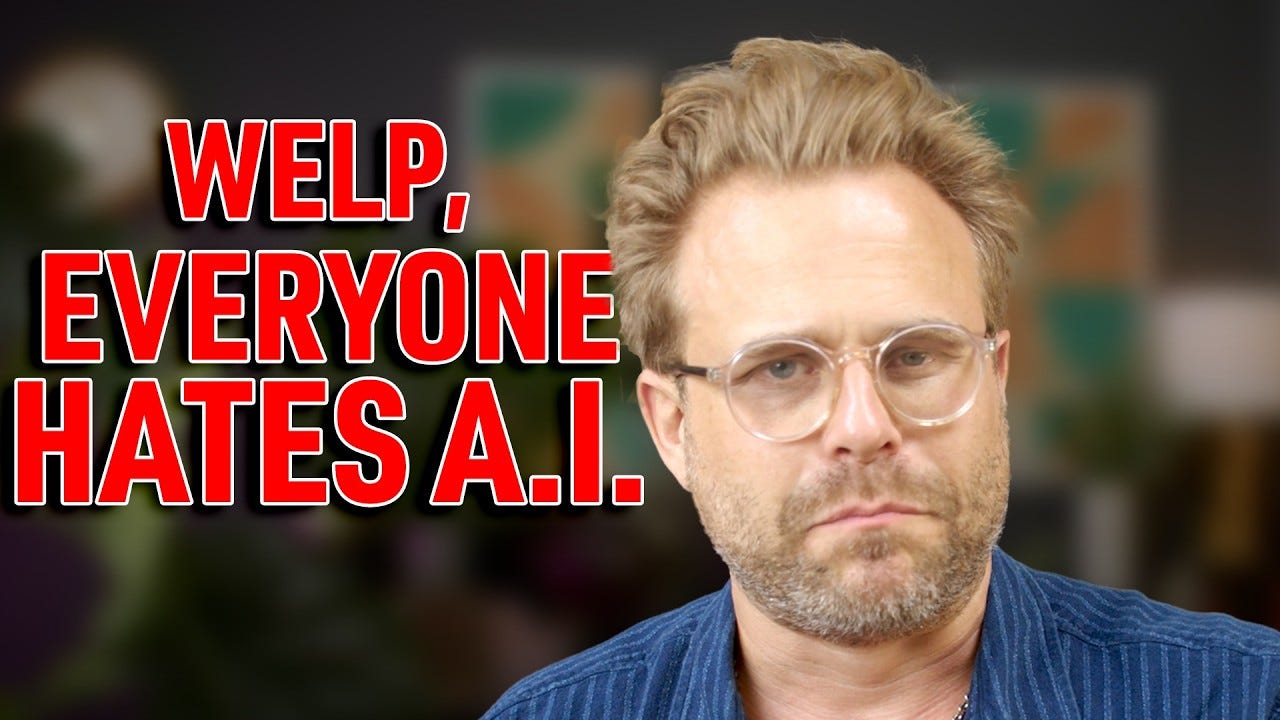
Adam Conover, a man who can only be described as what you’d get if a Reddit comment was a fursona, used Nazir’s controversy as Exhibit A in why AI is terrible and why people who use it are terrible in a YouTube video posted five days after the Commonwealth Foundation announcement. He did not mention that the author’s name had been cleared five days earlier, at least in the Foundation’s eyes. Instead, he and his guests used Nazir as a segue into the Dead Internet Theory, a popular dystopian idea suggesting that most of the internet has been overtaken by bots, algorithms, and AI slop. What we think of as the internet’s bustling town square is actually a ghost town full of Westworld hosts, still performing their programmed routines long after the guests have gone home.
But I think something else is happening.
What if the internet isn’t dead? What if we just can’t tell the humans and hosts apart anymore, and that uncertainty has convinced us none of it is real? The perception that the internet is being overtaken by AI-generated content may end up being more corrosive than the AI content itself. When we believe we’re surrounded by fake art, fake opinions, fake essays, fake comments, fake images, fake reviews, fake everything, we stop engaging with the new and unfamiliar. We start behaving like paranoid misanthropes. Authentic human interaction disappears not because every human has been replaced, but because we no longer trust that anyone is human in the first place.
The Dead Internet Theory becomes a self-fulfilling prophecy because we labeled the humans as AI and then congratulated ourselves for spotting the fraud.
It’s hard to precisely explain why something being AI-generated feels so disqualifying. AI content is treated almost like online leprosy. No one really wants to spend time consuming something AI-generated unless they were the one who generated it. They’re certainly not going to spend money on it. People rarely ask if AI is good. For most audiences, it can only be bad, suspicious, cheap, exploitative, embarrassing, or an automatic disqualification from consideration. The artificial taint also spreads to anyone who uses it. People who want to have their AI content displayed on the fridge are often treated with derision, while anyone trying to pass AI content off as their own is quickly labeled a fraud.
And if there’s one thing the internet loves, it’s identifying frauds.
Whether or not Jamir Nazir’s story was AI-generated matters, but the accusation did not need proof to do its job. No matter who won a Commonwealth Prize this year, the internet was probably going to come away shouting that some of it was AI. Partly, that’s just the social media environment we’re in. Outrage travels faster than nuance because nuance doesn’t make people feel like a little detective solving crimes from the toilet. “There’s AI slop afoot!” was always going to gain more traction than “This is a fine short story from a marginalized author.”
But the deeper issue is that we don’t always know what’s real anymore, and it’s only going to get harder to tell. Nazir’s story is actually something more unsettling than the usual low-effort machine garbage we call AI slop. It’s mystery meat. You can hold whatever opinion you want about who or what actually wrote “The Serpent in the Grove,” but we cannot definitively know. If it was AI, then it was slop good enough to fool a room of literary experts and win a prize. If it wasn’t AI, then a real writer’s career moment was dragged through the mud because his work happened to trip the alarm.
That second possibility should bother us more than it does.
We run into mystery meat all the time now. This essay, for example, is mystery meat. Maybe it’s AI-generated. Maybe it isn’t. Maybe it’s some depressing mixture of the two. What makes it mystery meat is not what it is. It’s what you don’t know. You didn’t see me sit down and type this. If I swear this is 100% USDA-certified human thought, you have no particular reason to believe me. In fact, you’re probably predisposed to believe I’m a liar.
We all understand that anyone can now be a fraud. We all have the means to access these models and the opportunity to pretend a thirty-second generation took hours of human effort. As for motive, you’re reading this. I clearly want your attention, and you’re giving it to me.
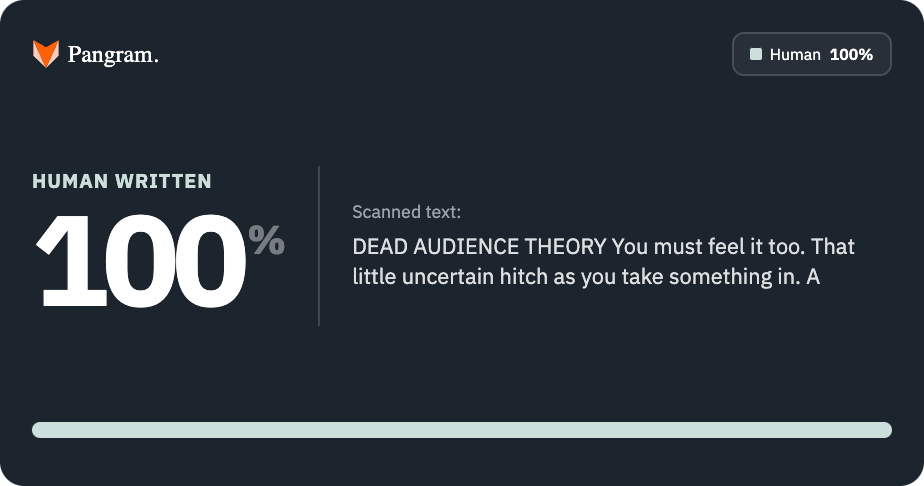
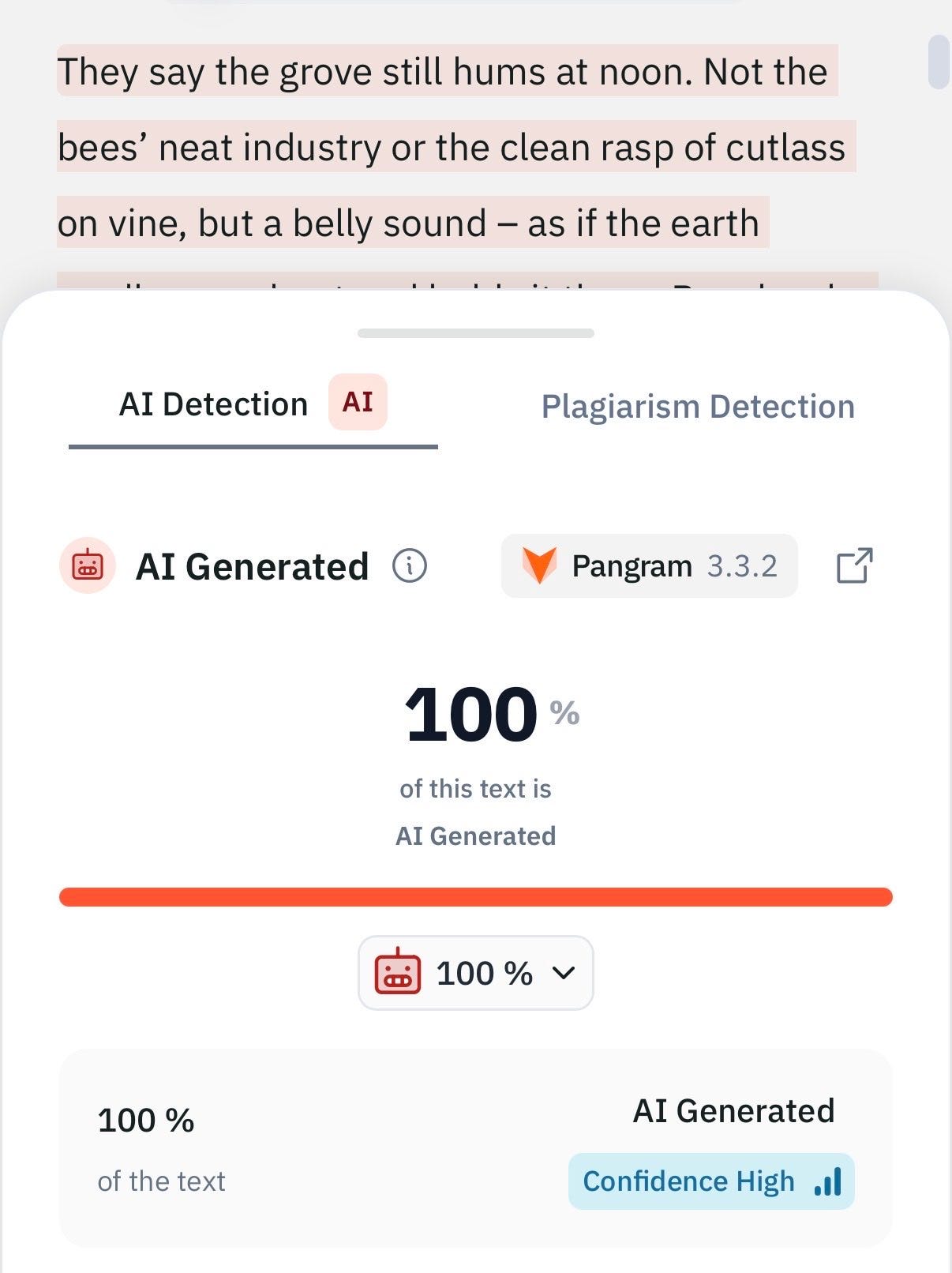
Not knowing the truth behind mystery meat should eat at us. We don’t have a reliable way to prove or disprove AI use. Not every generated image comes stamped with SynthID, and an AI detector like Pangram is just one machine squinting at text and making a confident guess about whether another machine wrote it. That isn’t proof. So much of Nazir’s problem came from Twitter pointing out that Pangram’s machine thought “The Serpent in the Grove” was 100% AI.
The reason the question “Is this AI?” doesn’t eat at us for very long is because it’s almost always followed by an answer. We don’t have the energy, time, or patience to do due diligence on every piece of content that crosses our screen. Every second we’re online, we’re bombarded by an endless torrent of stimulation. Most of it gets only a few seconds to win our interest before we move on. The question “Is this AI?” probably eats up one or two of those seconds by itself. Sometimes the answer is backed by clear evidence, but if we can’t spot something obvious, like a mangled hand with six fingers, we end up settling for a gut check.
What matters is that for all the reasons people don’t engage with AI, they also don’t engage with any work they think might be AI. Sometimes defaulting to “This is AI” feels like the safest answer. For anyone who describes themselves as anti-AI, the last thing they want is to be the idiot who argued “AI art isn’t art” and then got caught enjoying AI art. No one wants to be the Facebook Boomer saying through a full mouth of mystery meat, “This is a tasty burger,” only for someone to inform them it’s fake. I’ve felt like an idiot sharing a video with a friend showing a baby reacting to a rainbow bath bomb and telling him he needed to buy this thing and blow his baby’s mind, only for him to respond, “Dude, that’s AI.”
The worst thing we can do is try to answer “Is this AI?” by reading the room and deferring to everyone else’s gut checks. There’s always confirmation bias in the mix. Most people who read “The Serpent in the Grove” only picked it up after the accusation, meaning they didn’t go in blind. They were primed to think it was written by AI, so what they read screamed, “This was obviously written by AI.”
Some of the loudest slop accusers also have the shakiest understanding of the technology. They don’t use AI themselves. Why would they? They’re not hypocrites. But that kind of moral consistency can lead to ignorance. They don’t really know how the enemy works or what the enemy looks like, yet they want to fight this war and go in guns blazing, and the humans they’re trying to defend end up getting caught in the crossfire.
You see this everywhere now. A skilled photographer is using Midjourney because the lighting is too crisp. An aspiring model is too beautiful to be real, and not in the usual creepy online-guy way. People literally judge a self-published book by its potentially AI-generated cover and call the entire text a con job.
Sometimes all it takes is one person suggesting something is slop, and suddenly everyone starts collectively hallucinating fraud. Authors on Reddit watch in dismay as someone shows up to proudly announce they won’t read what they wrote because it’s AI slop. The accusation leaks through the thread like ethylene gas from a rotten apple, souring everyone around it.
The accusers often speak with the confidence of someone holding a master’s degree in digital forensics, pointing out “obvious tells” that don’t exist. The books on a bookshelf are facing the wrong way in a mirror selfie. A lifelong iPhone user is confident the Android phone someone is holding is wrong.
Sometimes they just squint and say something “seems off” because an unknown writer is too metaphorical, too grounded, too lyrical, too blunt, too normal, too weird, too anything. Really, the unknown writer just doesn’t write like them. Or the author can write and the accuser can’t. If the accuser tried to create what the author created, they would need to use ChatGPT, so it goes to reason the author must be using ChatGPT too.
The net result is that people don’t read the self-published book because they don’t know the author. They don’t give the new musician a shot because the song might be a Suno prompt. They ignore actual artists making actual art because the artists didn’t bring enough receipts. Even if an artist does show their work, someone will point out that “slop artists” can generate fake receipts too. The paranoia never ends.
And people stop engaging with genuine organic human content.
A false accusation doesn’t just hurt someone’s feelings. It suppresses discovery, preventing an unknown from becoming known. Every established creator today was once an unknown creator asking strangers for the benefit of the doubt. The fear of AI severs those tiny chains of engagement, where one stranger takes a chance, telling another stranger, who tells another, until eventually a career exists where nothing existed before.
Kane Parsons went from posting creepy Backrooms videos on YouTube to landing a major Hollywood adaptation before he was old enough to rent a car. It’s easy to imagine a world where those same Blender videos are immediately dismissed as AI slop and never get the momentum to go viral. Matt Dinniman became one of indie publishing’s biggest success stories before the internet was flooded with AI-generated novels. How are we supposed to discover the next Dungeon Crawler Carl if every unknown author gets thrown onto the slop pile before anyone bothers to read Chapter One?
We love the idea of discovering unknown creators. The internet was supposed to be a place where a nobody could upload something strange, brilliant, stupid, deranged, hilarious, beautiful, and find an audience without asking permission from the old gatekeepers. That was the dream. Now, the old gatekeepers are the only ones holding a stamp of authenticity and everything else is regarded with suspicion. Now, before a stranger can become a fan, they have to decide whether the creator is even real. That might be the single worst environment for creativity.
There’s no easy fix to the irony that people are attacking human creativity in defense of human creativity. There are only personal suggestions that work at an individual level. The first is that before we shout “This is AI,” we should ask the opposite question: “Is this human?” AI content is easy to dismiss because we assume no effort went into its creation. Before making the accusation, we should consider the potential blood, sweat, tears, hopes and dreams that poured into whatever we’re examining. We need to fully understand the stakes of the second question: “What if I’m wrong?”
Malcolm Gladwell says it takes ten thousand hours to become an expert. It takes about ten seconds to accuse someone of being a fraud.
AI art supposedly deserves no praise because it creates the appearance of skill without the struggle, but when real human work gets mislabeled, the accusation does exactly what people fear AI will do. It replaces the human with a machine and erases the labor behind the work. It turns skill into an illusion, effort into a lie, and the artist into some idiot standing next to a generative slot machine, pretending a jackpot was craftsmanship. The hours vanish. The drafts vanish. The practice vanishes. Their humanity vanishes. All that remains is suspicion, and the suspicion is enough to scare off the audience who might have helped the work survive.
Jamir Nazir is a real person. He’s not some prompt monkey trying to hack his way into literature. He’s a 62-year-old writer who says diabetes-related health problems have made conventional typing difficult. His writing process often involved using Android speech-to-text on his phone. Becoming a Commonwealth Short Story finalist should have been a major step toward recognition for a marginalized author. Instead, it may become a career-ending pitfall, forever tying his name in search results to the words “AI,” “controversy,” and “fraud.”
That’s the thing people miss when they treat AI accusations like harmless skepticism. They are not harmless. The internet is very good at starting fires and very bad at reading the arson report, and it’s easy for an audience to walk away remembering only the accusation. I’ve been lucky that whenever someone accuses me of using AI, they usually denounce my work and then immediately leave without reading another word. They haven’t stuck around long enough to do real damage, like bombing my reviews with one-star accusations, permanently poisoning the well for future readers.
This is probably going to sound like the worst possible take to a lot of you, but bear with me: AI isn’t going away anytime soon. While it may be the reason behind our paranoia, it isn’t the problem behind Dead Audience Theory. We are. We’re the audience. We’re the ones who need to change, consciously or not.
We’re trapped in the Uncanny Valley, and I doubt we’ll ever find our way back out. As the technology improves, there will probably be less obvious AI slop and far more mystery meat.
My hope is not that everyone learns to love AI, but that the backlash becomes less visceral and more precise. We can learn to live with uncertainty instead of trying to excise it. We need to stop treating suspicion as proof and remember that a human being can look artificial because artificial things were trained to look like us.
If you made it this far into this particular piece of mystery meat, then you’re already doing exactly that. Maybe I’m a writer. Maybe I’m a fraud who hit “generate” and let a machine argue for me. Even if you’ve read my entire bibliography, you still really don’t know. I could show you my revision history and argue that I spent roughly 23 to 28 hours over nine days researching and writing this. If getting distracted on Reddit and Threads for hours at a time counts as research, it might even be true. I could point to an AI detector score on this piece, even though I just argued those scores shouldn’t be treated as gospel.
If I’m putting all my cards on the table, I would also need to admit that I fed this article into ChatGPT and Claude. I use LLMs to fact-check, find typos, critique arguments, and poke holes in my logic all the time. Sometimes I even listen to them and tone down the Adam Conover insults. They seem to think I have some major grievance against the guy.
But the “I smoked but didn’t inhale” defense only opens the door to more doubt. Maybe I don’t have Gladwell’s ten thousand hours. Maybe I only have five thousand, and I’m using ChatGPT to make up the difference. Maybe I wrote this entire article at a fourth-grade reading level before telling an AI, “Fix this and make it gud.”
You don’t know. And you know what? Maybe it doesn’t matter.
You can eat a Big Mac without knowing exactly what’s in it. Later, you may hate yourself and decide it was artificial, overprocessed garbage. What matters is that you gave the mystery meat a chance, and you didn’t starve.
Human creativity needs human engagement to survive. Musicians need fans. Artists need snooty patrons. You read what I wrote, and that encourages me to keep writing. Small moments like that are what keep the internet we actually want alive.
I for one struggle with the uncertainty, and AI has only added to the swirling grey area that is reality. We definitely need to get more comfortable with just not knowing. Focus on what’s good versus not good, not what has “too many em dashes.”
Thanks for the tasty mystery meat.
👏