

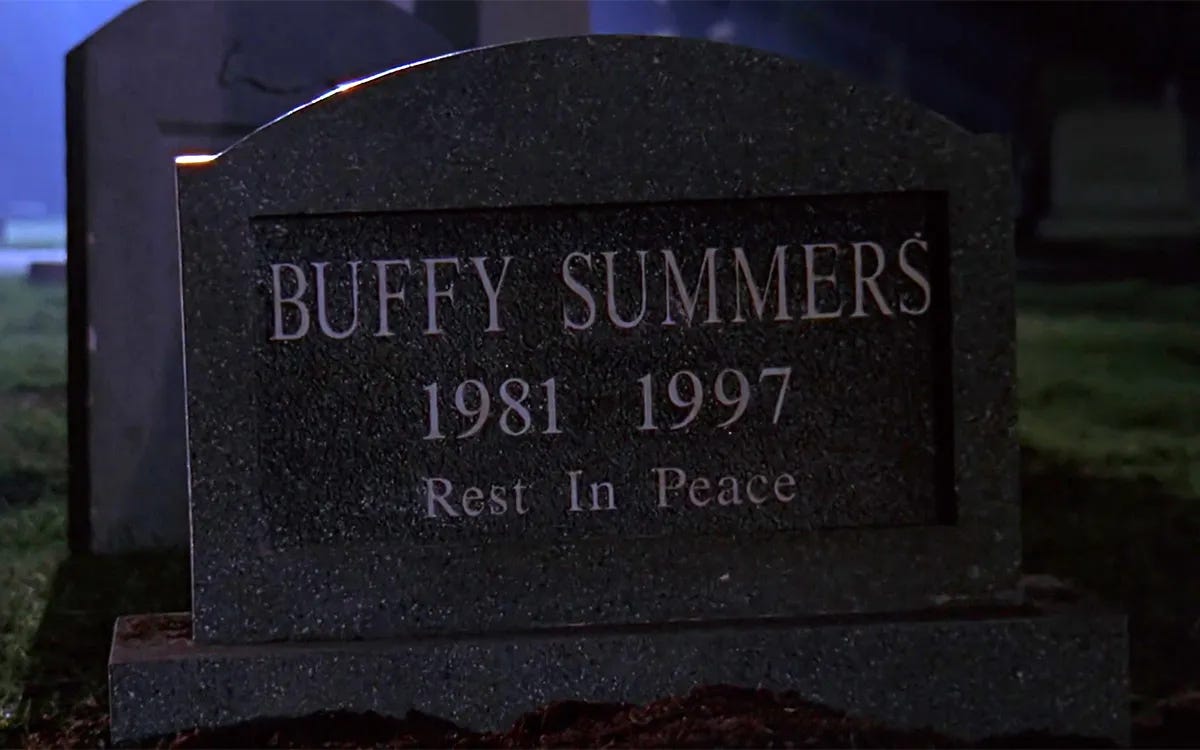
I’m exhausted from this era of nostalgia-sploitation where we refuse to let “The End” be the end. Maybe I’m just bitter from being done dirty too many times, but every reboot seems to run on the same formula now: shuffle the deck and reposition the original lead as the wise mentor for their functional clone who still has two good hips. So when I found out that they killed the Buffy reboot, I’m not mourning the loss. I’m honestly relieved.
These revivals always begin the same way. First comes the triumphant announcement that your favorite franchise is returning. Then comes the quiet clarification that not all the original elements that made you love it in the first place will be involved. With Buffy: New Sunnydale, it increasingly looked like, out of the entire Scooby Gang, the only one definitely returning was Scooby. Or Daphne, I guess, since it’s Sarah Michelle Gellar. Whatever. Somewhere in a conference room, someone clearly decided: “The show is called Buffy. We got Buffy. Good enough.”
Except it isn’t.
To be fair, the people behind the show insisted this wasn’t technically a reboot, but a continuation. A bold new take. The idea was to introduce a new Slayer while positioning Buffy as a mentor figure — you know, like Luke Skywalker guiding Rey. Or Rocky training Adonis Creed. Or Daniel LaRusso becoming the new Mr. Miyagi in Cobra Kai.
The focus was going to be on the next generation of the Scooby Gang. Kind of like how the teens from That ’70s Show eventually became the confused parents in That ’90s Show. Or how Zach Braff was promoted from lovable idiot doctor to lovable idiot teacher in the Scrubs: Med School reboot, or how Zach Braff was promoted from lovable idiot doctor to lovable idiot Chief of Medicine in the recent re-reboot.
They were passing the wooden stake. Like Bill Murray passing the proton pack to Finn Wolfhard. Like Indiana Jones reluctantly handing over the whip to Phoebe Waller-Bridge.
It was a winning, completely original formula that couldn’t possibly fail. The roles were cast. A full pilot was shot. Real effort was clearly made.
And then Hulu watched it.
…and passed.
From the outside, the project looked like a perfect storm of structural problems a fresh coat of paint couldn’t fix. Some characters simply couldn’t come back. Dead actors can’t reprise their roles, and the best we can usually hope for is a tasteful dedication card and a line of dialogue assuring us they’re canonically “living their best life on a farm upstate.” Buffy’s younger sister, Dawn, played by Michelle Trachtenberg, tragically wouldn’t appear in New Sunnydale, which effectively scratches Scrappy Do off the list.
Then there are characters whose actors have become liabilities. In modern revivals, those figures tend to vanish into thin air, leaving behind a strangely shaped hole and real-world discomfort to fill in the gap. On That ’90s Show, Danny Masterson’s crimes were so severe the writers couldn’t even joke about his absence. Personally, I think a recurring gag where everyone just mutters “We don’t talk about Uncle Hyde” would’ve been cathartic, but I also accept that my poor taste is not always a reliable compass.
For Buffy, that dynamic would obviously apply to Xander. Nicholas Brendon’s personal struggles have been well documented, and it’s hard to imagine a major streamer building a revival plan that includes a character tied to multiple arrests and convictions.
(Update: -sigh- And the day after I wrote this, Nicholas Brendon passed away. I don’t want to speculate, and hate to think that Hulu’s cancellation may have been a factor. Honestly, Buffy isn’t Buffy without Xander.)
The creator issue loomed even larger. Joss Whedon’s alleged behavior on the original set was a guarantee he wouldn’t have been allowed within 500 feet of the property. Unfortunately, for as shitty a human being as he is, Whedon is still the mind that made Buffy, and I’m done pretending that the original authors of a story can be replaced and it’ll still be the same thing. It’s not.
For all their flaws, the Star Wars prequels at least feel like the product of a single, coherent vision because George Lucas was at the helm, steering the ship with an ego that only an original creator can have. Without that “Fuck you. This is my story. I can do what I want,” you end up with studio execs handling a franchise and directors being kept on a short leash, worried about meeting fan expectations.
And then there’s the simple reality of time. Buffy is a show about immortal vampires played by very mortal actors. Bringing back characters like Spike or Angel would mean either ignoring the fact that Angel, the eternal 20-something, was now pushing 60, or digitally sanding down the decades like De Niro in The Irishman. Neither option inspires confidence.
So what were we realistically left with? Maybe Willow in a limited cameo. (Alyson Hannigan was never signed on as a recurring role.) Possibly Giles, though positioning Buffy herself as the wise guide would make him narratively redundant.
Most likely, it would have been Buffy and a group of carefully engineered functional equivalents trying very hard to recreate the chemistry of the original Scooby Gang. That’s a hard position to put Buffy’s character in without bringing along a sad, subtle undertone of an aging sorority mom still hanging onto the triumphs of her youth while all her Chi Delt sisters go off to make careers of their own.
And seeing that the new Buffy pilot reportedly underwent rewrites to give Sarah Michelle Gellar a larger presence, it’s safe to say the show was still trying to figure out what it actually was right up to the end. Was it a reboot or a continuation?
My guess is they ended up with a reboot nobody liked.
To their credit, the creatives clearly tried. Hulu ordered a pilot helmed by Oscar-winning director Chloé Zhao. That’s not the kind of swing you take if you’re planning to phone it in. It’s easy to imagine heartless executives in suits axing a beloved property without a second thought. In reality, pilots like this are usually tested, tweaked, and sometimes reshot before a final decision is made. If they still walked away, it suggests something more fundamental wasn’t working.
And given Disney’s well-established enthusiasm for making fresh money off old nostalgia, the bar probably wasn’t sky-high. The show didn’t need to reinvent television. It just needed to somewhat feel like watching an episode of Buffy. If it couldn’t clear that hurdle, do you really want to untie the neat little bow the series finale tied all those years ago?
Personally, I would have leaned into the continuation angle and taken the story somewhere new. It starts with Buffy Summers living out of a van, traveling across the country slaying vampires because it’s the only thing she knows how to do. She’s lost her posh, fashionable-but-sensibly-priced style, and you can tell the off-camera years haven’t been kind to her. Then you introduce a young Slayer who lost her parents to vampires and—boom—now you have Buffy in a maternal role she’s not emotionally prepared for, dealing with a troubled tween who needs protection and guidance.
Keep them on the road. Have them pursued by an army of vampire bikers to keep the tension running. Throw in a scene where Buffy is calling Giles back in London looking for advice, asking if she was ever this bad. The story practically writes itself.
And yes, I basically just described the Buffy version of a story you’ve seen several times before (Logan, The Witcher, The Last of Us, Terminator: Dark Fate, just to name a few). But goddamn it, that kind of story works. What matters is that it’s not trying to give you New Sunnydale. It’s trying to give you something different.
As it stands, they were trying to recreate magic with far too many missing ingredients. Buffy the Vampire Slayer was never just about Buffy. It was a genre-blending ensemble machine powered by fast banter, rich lore, and long emotional arcs, all packaged in a monster-of-the-week structure that barely exists in the modern streaming era.
The original series thrived on the interplay of a beloved group. Yes, the show was called Buffy, but it often felt more like Friends. If you can’t recreate that, don’t even try. With only Sarah Michelle Gellar in the mix, they were essentially promising more of the same, only to risk delivering a full season of Joey.
That’s a loss I’m perfectly willing to accept.