

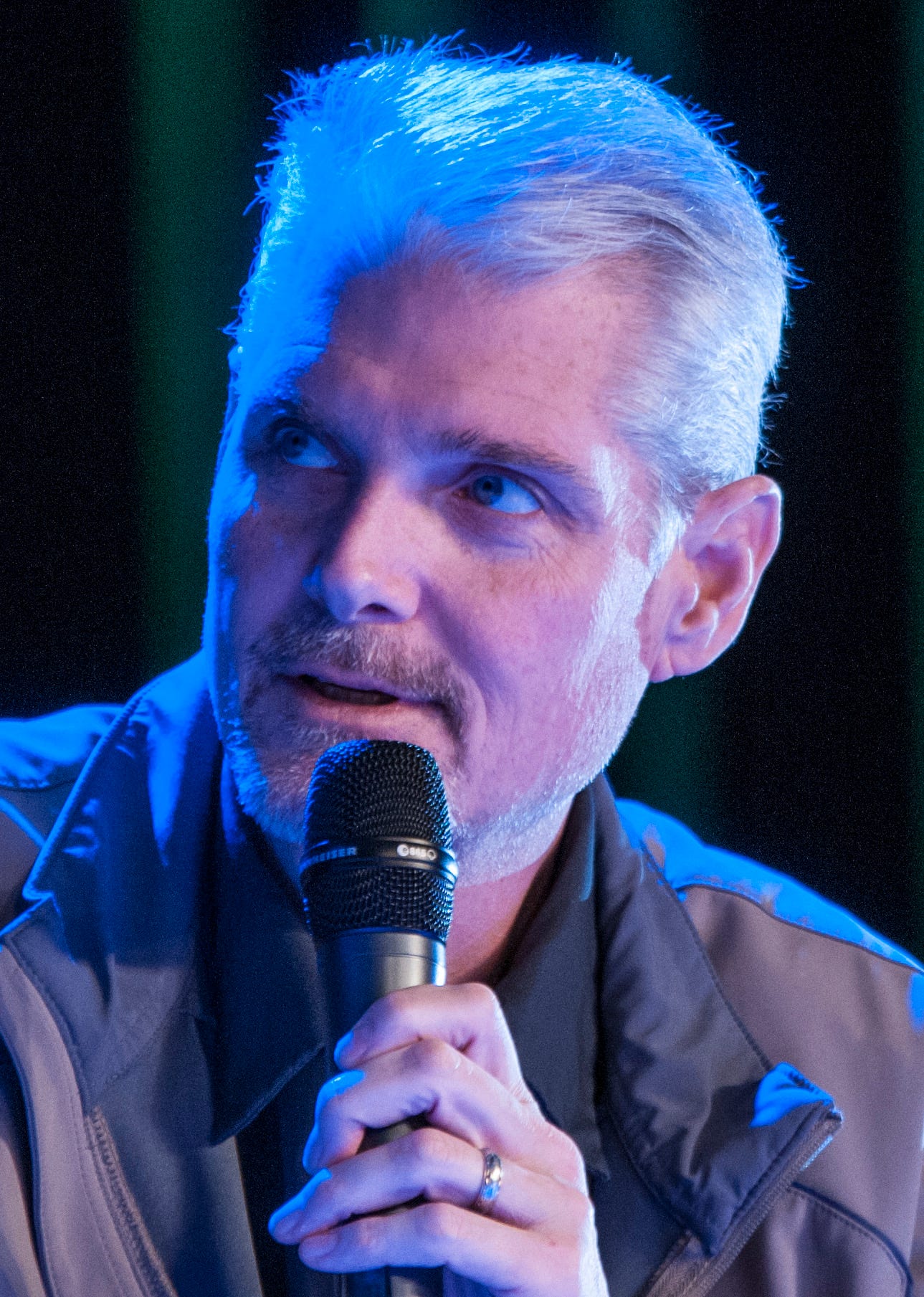
Legendary voice actor Tom Kane passed away last night.
Last night, I lost my father.
I’m still coming to terms with it, and I doubt it’s healthy, but I tend to write *around* my feelings more than actually process them, so here we are.
Here’s a story about who Tom Kane was as a person, as a father, but mostly, as a huge freakin’ nerd.
My dad was a huge sci-fi nerd. For most of his life, he was burning through pulpy paperbacks, but never really talked about it. I’m assuming it’s because he exercised self-restraint, whereas I often end up being that guy, lore-dumping on an unsuspecting victim.
But the second you brought up sci-fi, and he knew that you’d know what he was talking about? Jesus Christ. He’d let it out. I can’t tell you how many times I found an amazing story only for him to say, “Oh? Yeah, I read that years ago,” then he’d start going off about Dyson spheres and the Fermi paradox.
It’s impossible to truly explain how much it meant to him to work on Star Wars. He lived and breathed Star Wars his entire life. For him to become a part of that was such a defining honor. Yoda, Vader, and C-3PO were voices he was doing as a child, long before anyone at LucasArts handed over a script.
I grew up watching the original trilogy on VHS with him, and he was constantly repeating every character’s lines throughout the movie, and long after the credits rolled. Did I appreciate it? No. Actually, I hated it. Dad talked through EVERY movie, and it gave me a deep-seated grievance against anyone who dares to talk during a film.
At the same time, I hear “It’s a trap!” and I don’t see General Ackbar. I see my dad cooking dinner in the kitchen, talking to himself as one of the multitude of characters in his head. I hear Him from the Powerpuff Girls, and I don’t see the devil in drag. I see my dad stuck on the 101 freeway, rambling to himself to kill the time.
I’ve always had a weird perspective because I’ve never actually been a fan of my father. He was never Tom Kane, the voice of Yoda, Professor Utonium, etc. To me, he was just Dad. Whenever I saw how much fans loved him, it always came with the thought, “I don’t see what the big deal is. He’s just Dad. Please stop. This is going to go to his head.”
His fans also never got to see how much of a nerd he was. Every convention, he came away with a thick stack of autographed things, often gushing that he got to meet Starbuck from Battlestar Galactica or Lando Calrissian. He often found himself in a weird place where he was friends with Peter Mayhew and Mark Hamill but was also privately squealing every time he saw them because, oh my god, you guys, that’s Chewie and Luke.
The only time I really ever put him on a pedestal was when I started writing sci-fi. I kept it hidden from him and said nothing about it for the longest time. My dad grew up reading Dune and Hyperion Cantos. He taught me the Three Laws of Robotics before anyone ever got around to teaching me the Bill of Rights. To dip my toes into a genre he knew so well was kind of intimidating.
It didn’t help that the story I was working on could not have been a worse choice for a first novel. It’s called Partition: Critical Era, and the plot was insanely complex since it was told through two main characters who shared the same body. One existed during the day. The other during the night. Individually, their POVs told a linear story, but plotting it out on a timeline was just nuts. The effect often came before the cause. You were jumping all over the place. The events of Chapters 4 and 6 would occur at the section break in the middle of Chapter 5. The narrative was arranged like a finely made pocket watch, and if I tried to remove a single gear, the whole story would explode in my face and fall apart, and I’d end up spending the next month putting it all back together.
Eventually, I broke and sent the first half of the manuscript to my dad, the only person whose opinion on sci-fi really mattered to me. It was attached to a very casual-but-not-really email that basically said, “Oh, by the way, your son is writing a novel in that genre you exclusively read. Read it. Don’t. It’s whatever.”
Three days later, he called me and was so goddamn in love with the story. He broke down all the characters, obsessed over the core concepts and the technology, and couldn’t get over how it was like nothing he’d ever read before. He wanted more. Most of all, he wanted to know how it ended.
I was shopping during the call, and after he hung up, I calmly put my groceries in the car, got behind the wheel, then broke down and started flat-out ugly-crying.
For FIVE YEARS, I used every spare second I had to write and rewrite this manuscript, and after all that time, I only had an unfinished first draft to show for it. I was filled with self-doubt and didn’t even know if what I was writing was any good. I don’t know when in my life I decided to define myself as a storyteller, but I did, and it became a real existential crisis. I had reached such a low that I was on the verge of giving up entirely.
I never told him, but that phone call was the only reason I kept writing. He believed in me, and that’s why I still keep telling stories, for better or for worse, to this day.
No, actually, that’s a lie. One of the main reasons I kept writing was that he also wouldn’t shut up about my book. He started lore-dumping my book on unsuspecting victims any chance he got. The book I had yet to finish. It was so embarrassing, I HAD to finish the damn thing.
Then, three months after that phone call, he had a major ischemic stroke, and he lost his speech center in his brain.
When the man with all those voices in his head was reduced to saying only “Yes,” “No,” “And,” “But,” “Wow,” and “Oh God,” it was an irony so tragic it was almost absurd.
If the stroke wasn’t something everyone in the family had to learn to live with, I would’ve rolled my eyes so hard they would’ve popped out of my skull. That’s not real life. That’s the emotionally manipulative plot of a bad Oscar-bait film.
But it was real life, and goddamn, did he manage to get the most out of those words. Tom Kane was gone, but Dad was still with us, and we all became really good at charades.
He never had a chance to read any of my finished novels, but he still encouraged me every chance he got. He’d see me using my free time to write and say, “Yes!” with a crooked smile and a thumbs up.
He’d listen to the audiobook in the car, grip my arm, and repeat, “Wow!” and I would grin and keep my thoughts to myself.
I had always planned for him to narrate the Partition audiobook. I wanted it to be a project we could do together. I never told him that.
He still found unsuspecting victims, and even though he couldn’t lore-dump on them, he would still point at me and say, “Yes! Yes! Oh God! Wow!” which was Dad-speak for, “You like sci-fi. He writes sci-fi. You should read his book. It’s good.”
The unsuspecting victim would get none of that, though. They would just see my dad saying “Yes!” and then pointing at me, and I would awkwardly translate, “He’s trying to tell you I wrote a book,” then proceed to downplay it.
Dad always waved me off with, “No, no, no... Yes,” which translated to, “Don’t listen to him.”
Now that he’s gone, all I can think about right now is this stack of yellowing paper I once found inside a box of keepsakes in the basement. It was a short story painstakingly typed out on a typewriter, and it was good. Really good. There was no name on it, but it was clearly my dad’s.
When I asked him about it, he did what I did when he told people about Partition and downplayed it. It was just something he wrote in college for a creative writing class. Nothing important.
Years later, during that phone call about Partition, I found out that much of his pride in my writing was rooted in that story I had found. The man who lived and breathed sci-fi once tried to write his own in college, and it was good enough that his professor encouraged him to pursue it. He told my father he should try writing something longer and seriously consider becoming an author, but my dad brushed the idea off. He didn’t have the concentration to keep at it. Just sitting still long enough to write a single short story was absolute torture for him.
And forty years later, the “would’ve, could’ve” of it all still stuck with him. Tom Kane always wondered if, in another life, one that most likely came with an adult ADHD diagnosis and appropriate medication, he could’ve become that sci-fi author.
There was always some expectation that I was supposed to follow in his footsteps. I look so much like him, but that voice of his never carried over. What I did get from him was his love of storytelling.
I never told him that’s why I took his acting name as a pen name.
reading this made me both laugh and a little teary. though I remember your dad fondly from 'The Powerpuff Girls' and other cartoons, the way you've encapsulated you guys' relationship felt both heartwarming and sobering. Thank you for sharing him with us, even at the expense of your annoyance lmao.
Sending virtual hugs and love your way. 🩵
Yes! Yes! Wow! I Am Crying! ♥️😭