

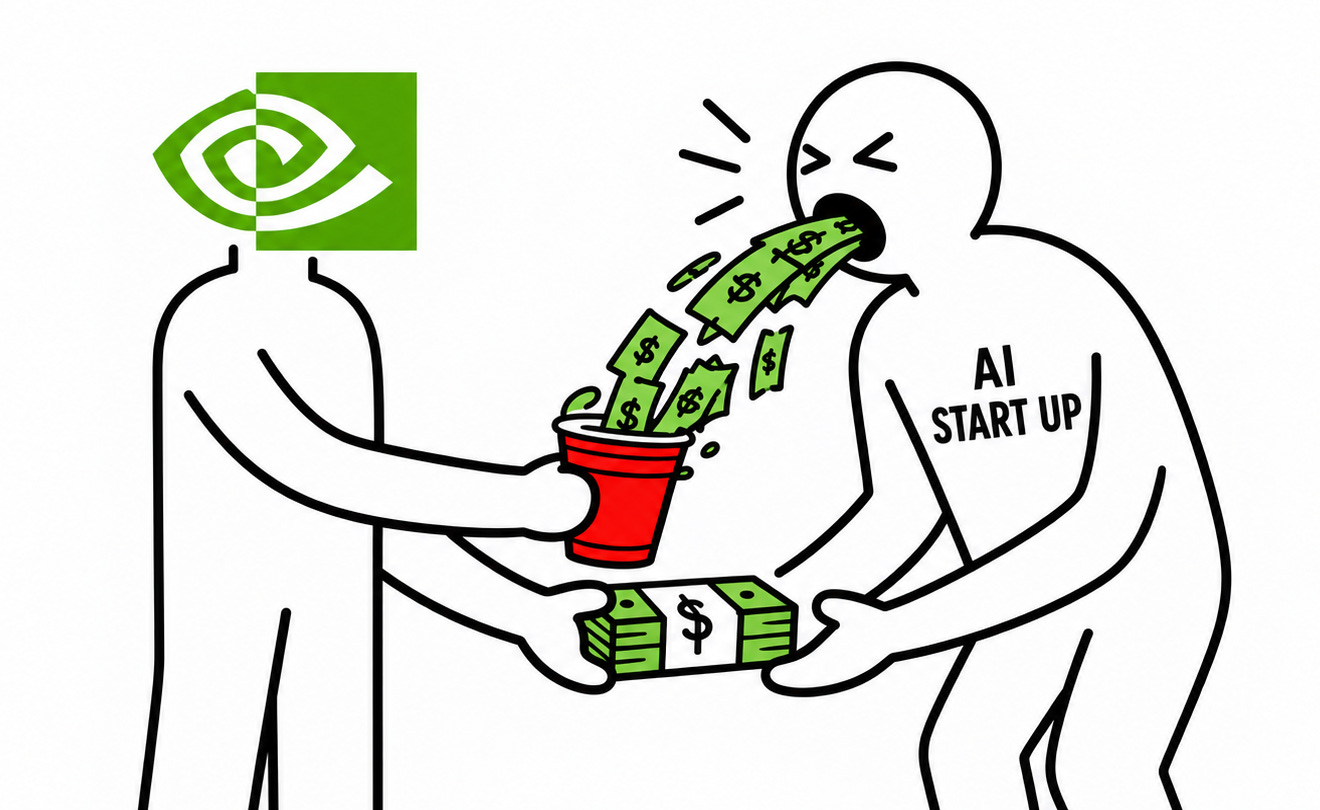
SANTA CLARA, CA— Nvidia CEO Jensen Huang dismissed growing concerns Wednesday over an AI bubble, saying critics misunderstood the sophisticated financial model underpinning the industry, known throughout Silicon Valley as “2 Girls 1 Cup Economics.”
Under the system, money goes into Nvidia at one end and comes out the other as an investment in an AI company. The company then immediately pukes the money back up to purchase Nvidia GPUs, feeding it directly back into Nvidia as revenue.
Meanwhile, the rest of the world watches in horror as the process becomes the sole load-bearing support of the entire American economy.
Wall Street analysts vastly approved of the model, mostly because they are the cup in this analogy.
“It’s a major improvement over conventional economics,” said Goldman Sachs analyst Richard Vale. “We’ve long moved past the idea that a company’s value comes from silly things like making products or providing a service that people want to buy. The fatal flaw in that system is that it requires customers to have money.”
Vale laughed. “Obviously that’s not where we’re headed with AI.”
According to Vale, the sequence in which workers earn wages, then use those wages to purchase goods and services, generating revenue for the companies providing those goods and services, is quickly becoming outdated.
“Companies have to pay people for that to continue, and it’s incredibly inefficient.” Vale shook his head. “Did you know that a lot of the time, a company isn’t just supporting one person, but an entire family? All these spouses, kids, and babies they didn’t hire are all just latching on, entirely financially dependent on a corporate handout, just because one of them happens to be an ‘employee’ working for that company. How is that fair?”
Vale is among the many who believe what most call the “AI bubble” is actually the beginning of a future-proofed closed economy in which consumers are optional.
“People keep asking what happens when AI replaces millions of workers, and nobody has money to buy anything,” Vale said. “Unless you’re one of the two girls, or the guy holding the cup, you’re not really part of the economy anymore.”
Vale shrugged. “You’re not our problem.”

One of the most successful participants in the new 2 Girls 1 Cup economy is OmniSynapse, a four-year-old artificial intelligence startup valued at $68 billion, even though nobody can clearly explain what it does.
“We provide foundational agent support for compute analysis in cloud-based models,” explained OmniSynapse CEO and newly minted billionaire Ethan Vale. “Before that, we decentralized the blockchain for NFC integration in multi-platform systems.”
Asked what any of that meant in plain English, Vale threw up his hands. “Fuck if I know, but it’s worth $68 billion.”
Analysts say what matters is that Nvidia invested $12 billion in OmniSynapse in early August. Two weeks later, OmniSynapse committed $11.8 billion to purchasing Nvidia GPUs. Nvidia announced the enormous order in an August 21 press release, driving up its shares by demonstrating unprecedented demand for Nvidia hardware.
OmniSynapse’s valuation, in turn, also increased due to its access to highly sought-after Nvidia hardware.
“If they have that much compute, they must be doing something revolutionary,” said billionaire investor Graham Keene.
OmniSynapse would later use its higher valuation to secure another $9 billion in financing.
“They had a phenomenal quarter,” said one analyst, unbothered that OmniSynapse’s reported revenue came to $52, mainly from employees using the vending machines.
The arrangement was so successful that executives are now experimenting with an advanced, futures-based form of 2 Girls 1 Cup Economics that no longer requires actual Nvidia GPU hardware.
In a recent press release, OmniSynapse announced the purchase of 500,000 RTX PRO Blackwell GPUs scheduled for 2029 production, noting, “It’ll probably be the 8000 or 7000 or whatever is out around then. You know, the really big ones.”
The next day, the company sold the rights to those unmanufactured GPUs back to Nvidia at a profit.
Nvidia subsequently announced that previously unavailable future GPU capacity had unexpectedly opened up and resold those same production slots to Microsoft at a substantial markup.
Several billionaire investors admitted they could no longer confidently explain where their personal fortunes came from, or even what the word “money” was supposed to mean.
“At this point I own shares in six companies that own shares in eight other companies that owe money to two companies I also own,” said Keene. “I use those shares as collateral for personal loans that I then use to pay off the other loans I secured with my stake in a company whose largest customer is funded by another company I’m invested in. And it’s all somehow marked as a loss on my taxes. I actually pay my tax guy more than I pay the government. Half the time, I get a refund.”
Keene went silent and stared at the table for several seconds.
“Man, how the fuck does my credit card still work?”
At press time, Microsoft announced the purchase of 500,000 unbuilt RTX PRO Blackwell GPUs, with plans to improve the user experience for the millions of Bing users who use Bing to get to Google.
That how the fuck does my credit card still work? ending absolutely killed me 😂. The whole circular Nvidia economy analogy was wild.