

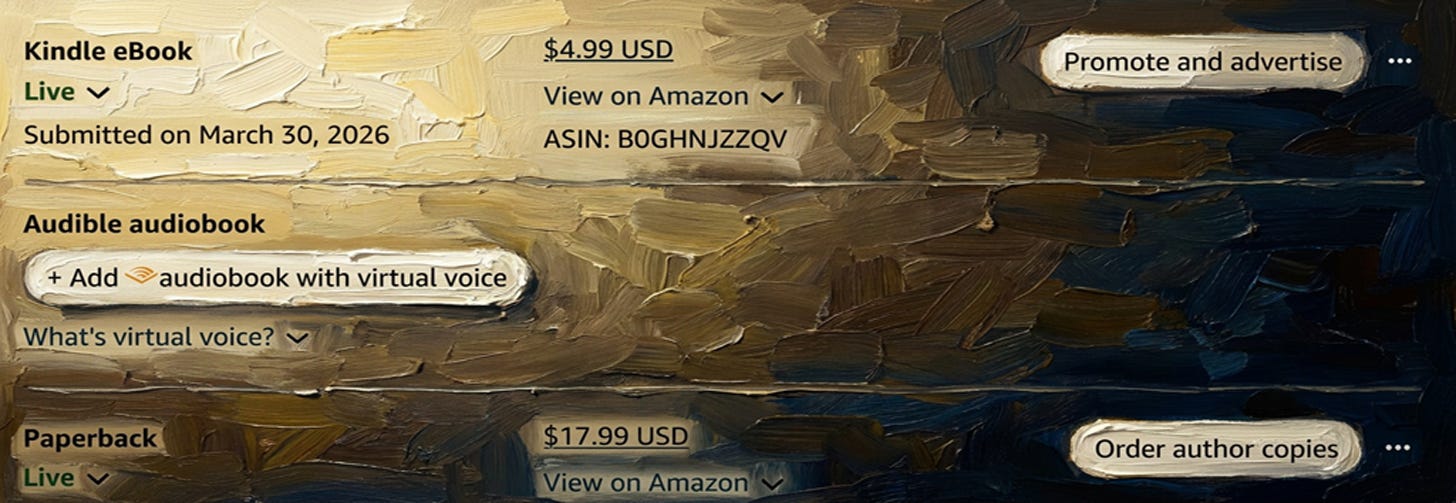
I logged into the Kindle publishing dashboard to futz with my new sequel, Take Back the Deep Estate. The ebook was live, the paperback was live, and right in between the two was a new slot: “Add audiobook with virtual voice.”
Not “hire a narrator.”
Not “Use AI and help Amazon trade out a creative industry for slop.”
Just “Add audiobook with virtual voice,” positioned as a natural next step, just above that hardcover edition I should probably get around to setting up.
That button bothered me more than I expected, and then I started connecting dots. My God, things got so much worse. Even with ChatGPT and Claude operating in galaxy-brain mode, I quickly became tangled in the red string. I’m still sitting here scratching my head, but I can say this much with confidence:
Three things are happening at the same time. Audible is forcing creators into a new royalty system and pushing “All You Can Listen,” while Amazon has introduced the Virtual Voice option directly into the Kindle publishing dashboard.
They’re connected.
In short: Fuckery is afoot, and everyone except Amazon is going to suffer.
Consumers will find Audible filled with AI slop. Authors and narrators will be paid far less until human narration is eventually squeezed out of the equation entirely.
First off, narration is not just reading a book.
I care about voice actors, and I don’t like that every time I compare the state of the industry today versus what it once was, I come away a little depressed.
My father, Tom Kane, raised NINE KIDS doing voice work. It was a well-paying SAG-AFTRA union career that put food on the table, paid for school supplies, medical bills, and Christmas presents.
Then there’s Christopher Harbour, the narrator of my Deep Estate novels. He does not just “read the words.” It’s very much a performance, one I can confidently say is on par with what “legendary voice artist” Tom Kane once delivered. He is also trying to raise his daughter on audiobook work, but the environment is a completely different beast.
Once, he casually mentioned during a recording session that he would like to bring another child into the world, but the numbers kept him from doing so. I found myself looking at the family photo on my wall, where my father and mother somehow managed to corral their horde of NINE KIDS for a Kodak moment.


I know my father and Chris aren’t equivalent examples, but I couldn’t shake the idea that something had changed for voice acting, and not for the better.
In Tom Kane’s world, audiobooks were made by publishers, in studios, frequently under union contracts at scale rates with pension and health paid on top. In Christopher Harbour’s world, anyone with a USB mic and a coat closet can call themselves a “voice actor.” Amazon didn’t cause the barrier to entry to collapse, but they sure as hell leaned into it.
ACX’s Audiobook Creation Exchange became the primary platform for voice actors to audition and bid for audiobooks. The bids came with no instituted floor, and instead of royalties being built in, they became a bargaining chip. The result was a race to the bottom, with a paycheck often a fraction of union scale, and much of a narrator’s pay based on speculation about future royalties.
And in a very corporate, “the solution to the problem is to make the problem a solution,” Amazon took the fact that voice actors were now expected to play the role of director, engineer, and editor in addition to being the sole performer, shrugged, and simply started calling them “producers.”
So when I saw “Add Virtual Voice,” it felt especially cruel.
Amazon, the company that kept the starving artists starving, was now offering a machine solution that didn’t need to be fed. There is no “Hire a human” button. That’s on an entirely different website.
As it stands, the only saving grace seems to be Amazon’s bone-deep need to be stingy.
The Good News: Amazon’s Virtual Voice sucks
So I clicked that “Add Virtual Voice” button and had the machine read my manuscript just to see what they were offering. I was expecting something on par with ElevenLabs’ cutting-edge text-to-speech models. Something that could simulate a breathing human and somewhat understand inflection, pace, and tone.
Nope. It turns out the cutting edge is too expensive for Amazon.
They don’t explicitly say which model they’re using, but judging by the voice naming convention and some common sense, they likely went with Amazon’s in-house AWS Polly. Polly has tiers of quality, and its latest and best model is specifically meant for long-form content like an audiobook.
They didn’t use that one.
You see, good text-to-speech eats up GPU and can’t be generated in real time, so they’d have to render the entire audiobook before selling a single copy. At scale, that would add up to a pretty penny, enough that the aspiring dystopian mega-corp might even consider a rounding error.
But if there’s anything I’ve learned from all my research, it’s this: Amazon won’t spend a dime unless they can also nickel-and-dime someone else.
Using the good model would imply they had some faith that these audiobooks would recoup the investment. Instead, they went with something that could be generated on the fly for a fraction of the GPU compute, so they wouldn’t have to spend a penny until someone hits play.
And the result? It sounds like a slight step up from a Speak N Spell.
A good narrator performs. They give characters distinct voices. They pace jokes. They carry dread. They understand when a line needs to land dry, when it needs to hurt, and, especially when it comes to my writing, when it needs to be stupid in exactly the right way.
Amazon’s Virtual Voice just says the words on the page and nothing more.
It is, quite frankly, trash.
Just take a listen to Christopher Harbour and Amazon’s Virtual Voice read the same passages:
The Bad News: Amazon’s Virtual Voice sucks
If Amazon weren’t Violet Beauregarde wearing a thousand dildos, giddily rolling around trying to fuck as many people as they can, as fast as they can, I would think this was a lazy attempt to monetize some Kindle feature they were planning to give away for free.
Which makes the matter only more confounding. The cutting-edge audiobook option is there, they’re just not using it. If they’re not actually trying to make AI audiobooks that can compete with audiobooks performed by a narrator, then why are they being pushed so hard as an option for authors?
I think it comes down to two things.
First, Virtual Voice audiobooks aren’t meant to be literature. Its content, and they need a lot of it. The cheaper and more disposable, the better. I highly doubt anyone will knowingly pay for these AI audiobooks, but Amazon isn’t really planning on selling them. Sure, the author can put a price tag on it and pretend someone might buy it, but really, it’s all meant to fill up their “All You Can Listen” catalog.
Second, Amazon is clearly looking ahead to what AI-read audiobooks will look like in the near future, and the changes they are making to their contracts and royalty system now are in anticipation of making that future a reality.
Ultimately, they want a human voiceover for your novel to be a luxury, not the standard it currently is.

The Spotify of audiobooks
Amazon wants Audible to be the Spotify of audiobooks, but since Spotify is already trying to become the Spotify of audiobooks, they have to move doubly fast to become the Spotify of audiobooks. However, doing so requires a fundamental change.
Spotify would be a vastly different place if it started out as the Audible of music, and their subscription offered a monthly Spotify credit that could be used to purchase a single album. Albums would still hold some monetary value to the consumer, and Spotify introducing an All-You-Can-Stream option at this late stage wouldn’t be an easy sell to creators. Studios and artists would be hesitant to devalue their own work and throw it into the buffet.
Audible’s economy is no different.
For about twenty years, the Audible deal was simple enough to explain to a golden retriever, or let’s be real, most authors, including me.
On the outside, Audible was an honest, clean handshake between a person who wanted a story and the virtual monopoly that sold it. The listener paid a monthly subscription fee, received a credit or two, and spent those credits on audiobooks.
Amazon would like the customer to stop doing that.
Exchanging money for things, expecting those things to be yours, not paying them every month to access those things? It’s an antiquated concept of ownership.
Why allow audiobooks to have value, when it could be access to those audiobooks? What they really want is to offer customers an all-you-can-eat content buffet.
As a consumer, a buffet of content is pretty fantastic. Once upon a time, you’d drop twelve bucks on a single album. Now, you hand Spotify roughly that same amount each month and get every song ever recorded, forever, on tap. It’s a genuine miracle of consumer value. Just think of the last time you bought an album.
No, seriously, think about the last time you bought an album because it’s a real problem.
The irony of Spotify becoming the solution to music piracy is that while consumers are no longer stealing from artists, the artists are still getting robbed. By paying $12 to Spotify each month for access to their buffet, we’ve essentially capped our music spending at a single monthly album purchase. Spotify then promises to divvy up that single album amongst the artists you listened to, and they do just that, except not really.
The fact that Audible is looking at this model and visibly swooning should worry every author and narrator.
The way I see it, Amazon wants to turn Audible into Hometown Buffet, but that requires cheap content to fill the warming trays. Of Audible’s ~1 million audiobooks, only ~150K are “All You Can Listen.” As much as they would love to just force their entire catalog into the buffet, they can’t, since most of their existing audiobooks come with a one-credit price tag they can’t unilaterally remove.
So everything they’re doing is to work around that issue, starting with finding a whole lot of cheap content, fast.
They’re staring at the disconnect between Kindle and Audible catalogs and scheming. Only 4% of KDP titles have an audiobook, and Virtual Voice is part of how they plan to bridge that gap, by giving authors a fast way to make cheap audiobooks with AI.
But here’s the thing: The vast majority of these books simply aren’t worth turning into audiobooks the traditional way. Over 90% of self-published books sell fewer than 100 copies. A great deal of these dusty, unread novels end up on Kindle Unlimited, Amazon’s eBook buffet, with the author reasoning, “Well, if they won’t buy the ebook, maybe they’ll read it if it’s part of their subscription, and I might get a quarter and a couple pennies in exchange.”
It goes to reason that the authors of these unread novels will do the same with Virtual Voice. “Well, if they won’t buy my book, or read it when it’s free, surely they’ll listen to it, right?”
Initially, I figured Audible would wait just like Kindle for the author to give up on people buying their AI audiobook before offering it as part of the buffet, but it turns out they cut that step out entirely. If you opt to create a Virtual Voice audiobook and your ebook is on Kindle Unlimited, the audiobook is automatically enrolled in Audible’s All You Can Listen.
That’s why Amazon’s Virtual Voice sounds like crap.
They don’t expect anyone to buy these books. Optimistically, readers might listen to a tiny fraction of these AI audiobooks for free, but for the vast majority, their popularity won’t change just because RoboCop now narrates them. They will, however, fill up the All You Can Listen catalog with cheap content that makes the buffet look more worthwhile.
Just don’t look too closely at the mashed potatoes.
Audible’s new bullshit math
Right now, Audible is trying to exist in both worlds: customers are still exchanging credits for audiobooks they’d normally buy, while Audible is also offering free audiobooks on top of that. There’s just one catch: Those free books aren’t actually free. Somebody is going to have to pay for them, and it sure as hell isn’t going to be Amazon.
This is where the new royalty system comes in.
Let me be clear here because I’m going to use this term a lot: “bullshit math” is my stand-in for the overly complicated way a streaming-style buffet pays creators. The term is the result of spending an entire weekend using both ChatGPT and Claude to help me understand Audible’s new royalty system and how it meshes with the Virtual Voice rollout.
Initially, I came away with more questions than answers. I can’t tell you how many times I shuddered and said out loud, “WAIT, WAIT, WAIT, WHAT?” Eventually, I landed on one overarching answer: Some bullshit math happens, and then they pay you less.
To which Claude and ChatGPT both said, “Yeah, pretty much.”
Topline, Audible wants you to know you’re going to make more money!!!! They’re flashing “40% royalties are now 50%!” and making it rain clip art dollar bills. Then they get into the details, and it’s far from that simple.
They have it all spelled out in their documentation, sure. They even show you a formula, and it’s all so easy to figure out. Just calculate:
It’s just that simple.
Really, the whole mess is a hodgepodge of terms, variables, and conditional statements across separate websites, and so much of it is left vague or undefined. But here’s the extremely simplified version:
The old system was messy, but at least it was messy in a way you could vaguely recognize. Someone bought your book, either with cash or with an Audible credit, and you got a cut. That cut would always be smaller than expected with a credit. After they run their patented allocation-factor bullshit math, the value of an Audible credit was never anywhere near the listed price. The 40% royalties were more like 21-18%, but at least the basic transaction made sense.
A customer spent something on your audiobook. You got paid for your audiobook.
The new system is: Someone bought your book, so take two Tylenol and buckle the fuck up.
Audible now starts with something called “Member Value.” This is the chunk of money they’ll be divvying up, so it’s pretty important to nail down. Naturally, they don’t give you any concrete numbers, so it stays vague and nebulous.
They also give you two contradictory definitions on the same page. In its video explainer, Audible says Member Value starts from the average amount received from all members of a plan, minus taxes, promotional discounts, and fees. In its written FAQ on the same page, Audible says Member Value starts from that plan’s monthly membership revenue, minus taxes and fees. There is no mention of an average or promotional discounts.
So either Member Value is the monthly subscription of the person who bought your audiobook, after Audible subtracts taxes and its suspiciously undefined “fees,” or it’s an average of all the members in that plan, after it’s fed through some bullshit math that lobs a chunk off to account for Audible’s free-trial-and-discount machine.
That’s going to be two very different amounts.
Whatever. This isn’t even the main point of fuckery. Member Value is basically their monthly subscription. That’s the chunk of money royalties are now coming from, not the credit itself.
What matters is that, under the new system, an audiobook purchased with a credit and an audiobook consumed through All You Can Listen are in the same single-user royalty pool and only weighted by their price. That’s a problem for everyone involved, but it’s especially shitty for the audiobook that costs a credit.
Now, I’ve written and rewritten this part three times, painting a full picture, showing the math, then not showing the math, trying to best explain this mess in a way that won’t make readers eyes glaze over or just sound like some author bitching about royalties. Here’s the best way I found to get it all across. To put it in the simplest way possible, using grade school math, and extremely round numbers, imagine this:
Someone walks into a bookstore and buys Welcome to the Deep Estate for a book club credit.
For the shopper, the credit is worth one book, as it has been for the past 20 years. For the new royalty system, the credit just means she can pick a book. Her monthly subscription fee is the actual value, and that’s $10.
The Deep Estate is normally priced at $15, but Jeff Bezos ignores the list price and hands Chris and me our 50% royalty of that member value, $5.
However, on the way out, the customer stops by the “Free books” bargain bin and grabs a book. After she leaves, Jeff Bezos looks at the list price of that free book and sees it’s also priced at $15.
He does some quick bullshit math. He adds the list prices together then divides The Deep Estates price by the total. (15/30 = 0.5) He then multiplies that by the Member Value ($10 x 0.5) then applies the 50% royalty rate.
The result? Jeff Bezos takes the fiver back from Chris and me. Now we get $2.50, and the author of the free book gets $2.50.
But wait!
The customer immediately turns around and walks back in, apologizing. Maybe she will take that trashy free romance she was eyeing. This book also conveniently has the same list price as the other two, so Jeff Bezos takes the money back again, does the same bullshit math, and divides it three ways, leaving Chris and me with $1.67.
The end result is that the customer walks away thinking she only bought one book, and you know what? Technically, she did.
Chris and I just ended up paying for the other two.
And no matter how many “free but not really” books she takes, the store won’t lose a single penny. Amazon being Amazon, they made sure they’ll always make 50–70% of the Member Value no matter what. This book splitting can only ever make them more money.
That’s the new royalty system.
And I’m sure you’re probably saying, “Yeah, but what are the chances someone is going to listen to multiple audiobooks in a single month?” and that’s the real kicker of this fuckery.
They don’t need to finish them.
They only need to listen long enough for each one to count as a “Qualified Listen,” which, for your average novel, appears to be anything over 30 minutes.
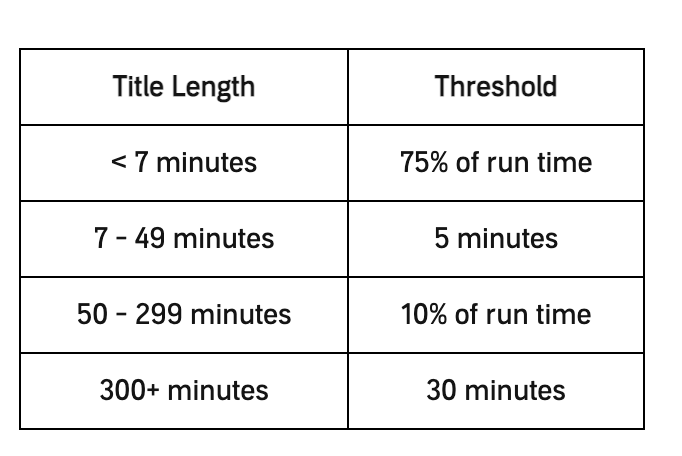
An All-You-Can-Listen audiobook doesn’t need to be worth your time. It just has to be worth giving a shot. The listener simply needs to play the prologue and a chunk of Chapter 1 before deciding it sucks and moving on, and that free novel can cut a major chunk of our royalty.
Adding in a tidal wave of unlistenable AI-generated audiobooks is only going to make the situation worse. The more disposable the free catalog becomes, the more listeners will bounce around, triggering Qualified Listens.
At the same time, paid audiobooks are at a distinct disadvantage because they still require an Audible credit. If you repeated the exact same situation, only now Welcome to The Deep Estate is also in the free books bargain bin, the result would be exactly the same. Audible’s new royalty system is forcing us into a post-credit economy where an audiobook being worth buying is just a barrier with no benefit.
If a paid audiobook sucks, they can always request a refund to get that credit back. But for a free audiobook? There’s nothing to refund. The free novel that wasn’t worth listening to still eats into the royalties of the ones that were.
At some point, excluding your work from All You Can Listen will cost creators real money.
In the long term, it’s also going to cost us human narrators.
The Human Cost
I make a point of not referring to Welcome to the Deep Estate as “my audiobook.” The Deep Estate series is very much the collaborative work of Christopher Harbour and me. I wrote and directed it, but Chris provided the voice, talent, audio engineering, editing, along with his own spin, which made the end product far better.
It’s to the point that whenever anyone asks about the sequel I just released, Take Back the Deep Estate, I’m actually telling them not to read it.
Wait for the audiobook. Trust me. It’s going to be amazing.
Amazon clearly sees this kind of collaboration as inefficient, and when all of this fuckery comes to fruition, it’s going to put both the narrator and author in a tough spot. Chris and I also share royalties, but that kind of profit sharing only works if there’s enough profit to share.
If narrators can no longer rely on speculation to make a recording project worthwhile, they’ll need to up their rates, but they’ll find themselves fighting against the current, pushing higher bids in the middle of ACX’s race to the bottom.
Maybe they’ll forgo royalties entirely for a higher up-front payment, and risk the chance that they could potentially record a bestseller and find themselves stuck holding a single paycheck.
Maybe they’ll have no choice but to learn to love the bomb and embrace ACX’s AI voice cloning services, because of course that’s a thing. It’s currently in beta. If they stop performing and start generating bespoke text-to-speech, then maybe increasing their volume could make the numbers work.
Or maybe they’ll just eventually get the message that they’re outdated and no longer needed. Gone the way of the horse and buggy, except for the few we keep around to splurge on romantic rides around Central Park.
As for authors? Well, we already have Amazon’s solution. It’s sitting right there on the dashboard: “Add Virtual Voice.”
Amazon loves authors. Not only do we put up the money and do all the hard work just so Amazon can take an outsized cut, but we’re also paying Amazon per click so that people might find our hard work in their search results. That alone is an insane relationship when you frame it in the context of the Bezos brick-and-mortar bookstore.
“Yeah, we’ll carry your book, but you gotta pay us a dollar anytime someone touches your book, or it’s going in our basement pit.”
When you get down to it, authors are Amazon’s favorite rube, and you don’t cut rubes loose, you string them along. Meanwhile, narrators made the fatal mistake of not being Amazon.
Abusive and toxic relationships are sustained by the abuser becoming the victim’s everything. “You are nothing without me! There’s nothing out there for you. Everything you have is because of me!”
They don’t like that the author is working with someone other than Amazon, and it’s not enough that they also keep the narrator under a controlling hand. They’re rightfully worried that the author and narrator might start talking behind their back, because we are.
But with a Virtual Voice narrator? That’s another lever they control.
Amazon won’t ever hear their Virtual Voice murmuring to the author in the other room, “I don’t like the way they treat us. There’s gotta be someplace that’s better than here.”
Their Virtual Voice doesn’t narrate with the hopes of turning it into a decent career.
It isn’t trying to raise a daughter.
It just reads the words on the page.

man that video of voice comparisons has me kind of fucked up, crazy