

Author’s Note: Each week, I will release a portion of the story along with the accompanying audio drama episode.
In a quiet room that smelled of antiseptic, musk, and death, Odetta Brown lay taking shallow gasps, surrounded by hand-me-down flowers. Her black skin, pale and jaundiced, lay draped over bones. The dim light deepened her cheeks into pits.
Elena Lopez was Odetta’s only visitor. Not even the hospice cat came to bother her. The nurse checked the slow spiral which were Odetta’s vitals, and felt no pang from knowing the crash was coming. All she could do was soften the landing.
A fingernail brushed against her wrist, and Elena flinched. Two cataracts peeked out of slits, and with surprising lucidity, Odetta croaked out, “What’s that say?”
Elena looked down to the simple letters etched in a serif font on her inner forearm, inked in a place she would always see, keeping a name close so she would never forget. After six years, the edges were starting to bleed.
“Mateo,” She said, then cleared her throat and tried again, “It says, ‘Mateo.’”
Odetta’s eyelids wavered, and for a moment, Elena thought she had fallen back asleep; then the old woman muttered, “Your son?”
Elena hesitated, then admitted softly, “Yes. He was my son.”
Odetta reached out and took hold of Elena’s wrist. She traced the letters with a trembling thumb. “You’re still a mother. You feel it in your soul. All that love and no one to give it to… It’s hard, I know.”
Elena nodded, trying to fight the urge to pull her hand away from Odetta and the memories she dredged up. She didn’t want this woman’s last words to be about her son.
“But…” Odetta paused to take a long, raspy gasp, then another. Elena could see their effort as if the old woman was physically dragging the air into her lungs by hand. Odetta continued, “When they go, they’re not gone. They’re around. Some so silly, they stick around.”
Odetta let out a laugh, then coughed, each shaking her frail body harder than the last. Elena brought the hospital bed backrest forward, offered a napkin, and waited. It came back stained with the evidence of Odetta’s decline.
Elena reached to increase the morphine and ease her passage, but the old woman stopped her with a plea, “I can’t die here. I need to be home. I could hold his hand, show ’em how.”
Many of her patients had this wish, and Elena’s heart ached at the refusal she had to give. The request’s reality, practicality, and impossibility all collided in a simple, “I’m sorry, that’s just not possible.” And then, she turned up the drip.
“But Eugene’s got nobody.” Odetta’s voice cracked, a tear tracing a path down her cheek. She motioned weakly towards the side table, her energy fading. “You’re a mother. Please… He’s alone. You’re a mother. You know…”
Odetta’s hand fell to her side, and she went quiet, breathing her soft gasps. Elena knew the woman would not wake again.
She turned to the side table, where Odetta’s keys and a photo album lay. Elena thumbed through the first few pages, seeing the faded snapshots of a much younger woman and her baby. She smiled as that baby grew up in each photo into a little girl grinning with two missing front teeth, her hair lovingly braided into platts. Elena pulled the picture out and checked the back. Odetta had a daughter, Yolanda.
Then Elena turned a page, and Yolanda was gone, but the baby book continued without the baby. Photo after photo, Odetta celebrated a child no longer there, posing beside birthday cakes and Christmas presents alone. Elena could almost see her setting the timer on the camera and rushing back to her seat beside a second empty chair. That lone woman overflowing with love… Elena understood it all too well. It was the type of love that made you smile every time you looked down at the ink in your skin because you knew a name would forever haunt you.
Odetta Brown died six hours later, and once visitation hours were over, Elena helped move her body to a cold chamber. This was usually done to minimize the chances of the living being unnecessarily reminded of what awaited their sick loved ones. Hospices are, after all, the most polite, quiet, and cost-effective way to process the dying into the dead.
No one would mourn Odetta. One of the funeral homes on rotation for taking care of the unwanted would hold her body for up to 30 days, then cremate her on behalf of the county. No rituals. No minister. No last words. Her ashes would be kept in a plastic bag next to her keys and baby book. Under state law, they would sit in storage for 180 days just in case someone materialized. After that, Odetta and the memories of her child would be destroyed.
Except Elena couldn’t bring herself to put the baby book and keys in the cardboard box. They ended up in her bag instead. Out of all the dead, Odetta seemed to linger, and Elena didn’t know why. She sat at the nurse’s station, about to clock out, when she realized it was Eugene. Odetta said, “Eugene’s got nobody.”
What if Eugene was an elderly neighbor or cat nobody knew to check up on? The old woman collapsed next to the baby food at the grocery store and never recovered. She never had a chance to return home. No friends or family ever visited, and her emergency contact was 9–1–1. Elena was likely the only person who knew someone needed to check up on Eugene.
She flipped through the photo album again, looking for a potential Eugene. There were no men in any of the photos, or anyone else for that matter. Just a disturbing number of pictures of a lonely woman wasting her life, mourning a dead child. The last photo was taken less than a year ago. It was a Polaroid of a decrepit old Odetta smiling at the kitchen table, making biscuits next to a mess of flour. Elena took a closer look. There was something in the flour. Were those tiny handprints?
Elena sighed, “What the hell am I doing?”
She was dead tired, eying the Burger King Drive-Thru along the way to her apartment, an unopened box of Merlot, and a Netflix reality show she could fall asleep to. Instead, she pulled up Odetta’s patient file and wrote down her address.
The neighborhood was block after block of million-dollar ‘starter homes’ and luxury duplexes that would forever be outside Elena’s price range. In the middle of it all was Odetta’s house, standing out like a sore thumb with its air of decay and neglect amidst cookie-cutter modernity. As Elena approached, the keys felt ancient and heavy in her hand. The lights were off, and it didn’t look like anyone was home. She unlocked the door, and it creaked open.
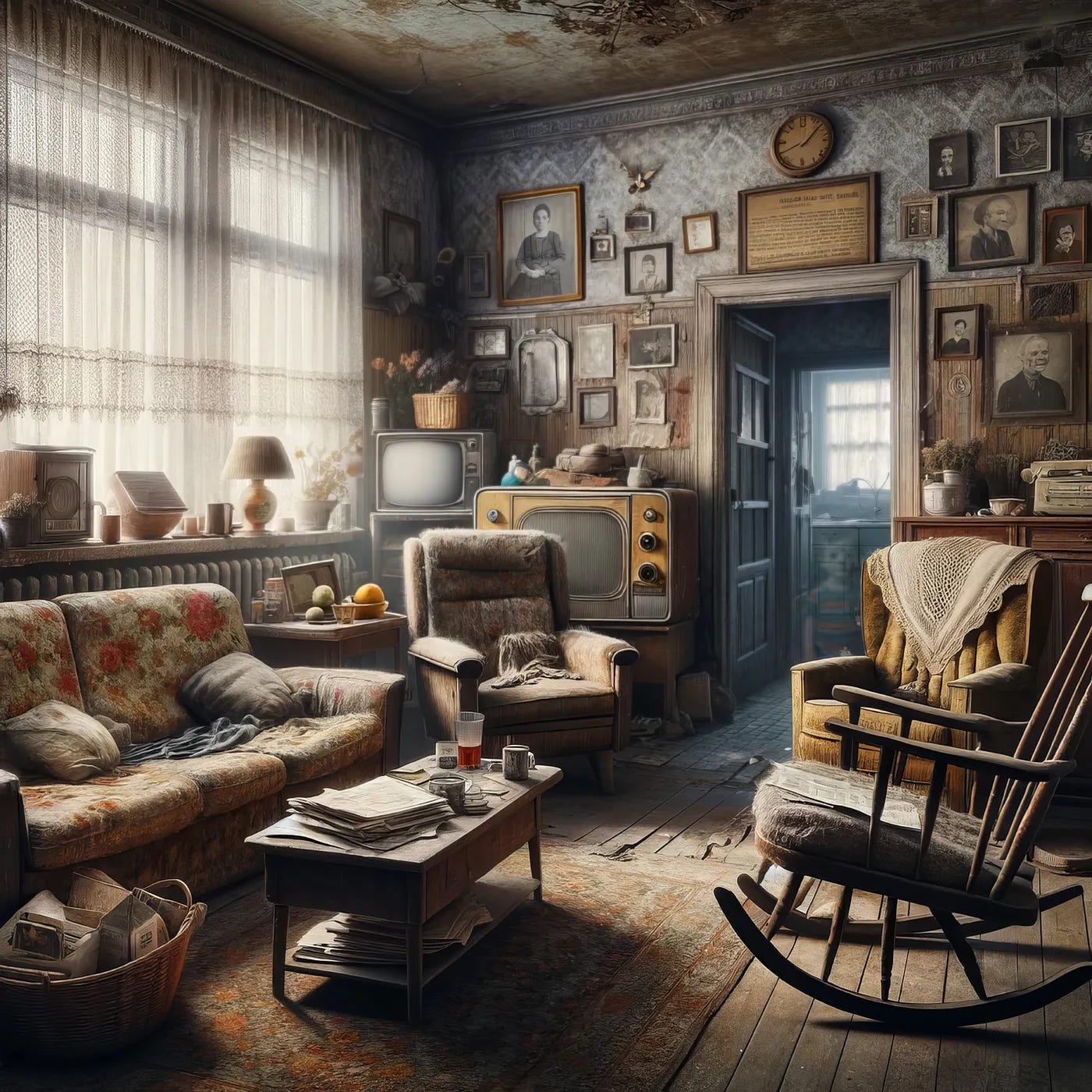
The air inside was heavy and thick with age and cigarettes. Elena flicked on a light switch. A flash and a pop came from the light fixture above. Its remaining bulb flickered to life with a dull, yellow glow. A roach found itself in the spotlight and disappeared into the kitchen. Picture frames lined the entryway, each capturing moments of joy with a child no longer present.
Elena entered the living room and took in all the toys scattered about.
“How far gone were you?” Elena asked, trying not to wonder if she wasn’t too far behind. There were times around Christmas when she found herself alone with her wine, perusing the toys she would have bought Mateo if he was still around, but unlike Odetta, her shopping cart never made it past checkout.
She broke the silence and called out, “Hello?”
Elena’s words briefly hung in the stillness, unanswered, and then an unsettling creak came from above. Her hand trembled against the banister as she climbed the stairs to the second floor, each step letting out a whine of old, warped wood. She hoped to God that Eugene was a dead goldfish or dry houseplant. This house was creepy enough without a corpse.
Elena mustered the courage to call out again, “Eugene?”
Silence.
The upstairs light flickered, casting eerie, dancing shadows over peeling wallpaper and gilded frames; more photos of a mad woman celebrating the life of her long-dead child. Clinging to her phone for dear life, Elena cast its weak beam across the narrow expanse. She couldn’t shake the feeling that she wasn’t alone — that she was being watched — and that feeling only intensified with each step. The hairs on her arms stood on end, and her breath caught in her throat as the beam landed on the third door.
It was ajar, held open by a blur — a retreating hand slithering back into the darkness. Elena yelped, her heart thumping wildly against her chest like a frantic bird trapped in a cage.
Just as she began to convince herself that it was a trick of the light, the door slowly creaked open, the hinges protesting in a shrill, piercing shriek. An inky darkness lay beyond.
Elena looked back down the stairs. She could run. She should run. Instead, she called out, “Eugene, is that you? Could you come out here… please?”
Out of the shadows, a Tonka firetruck emerged, moving on a squeaky axle. Elena stared at it in confusion, then directed her phone’s light into the dark room the toy had come from. She stepped forward, trying to will her phone to shine brighter.
“Eugene? Odetta sent me — “ she began, but before she could finish, the firetruck lunged forward. Elena yelped and jumped out of the way, the toy crashing into the wall and clattering down the stairs.
BANG! The sudden deafening slamming cracked through the house, making her jump out of her skin. She whirled around. Whatever it was, it was coming from the kitchen below. BANG! BANG! BANG! The sound came again, dredging up a memory of Mateo discovering the cupboard with the broken child lock. She raced downstairs, half expecting to find her son holding onto the counter, his eyes wide with glee as he repeatedly slammed the door shut. Instead, there was just a lone cupboard rocking on old hinges. Empty except for a rusted-out can of green beans, circa 1997.
Elena clenched her fist to stop it from shaking, “Hello? Is somebody there?”
The sudden hiss of static roared in response, sending a jolt through Elena as she faced the old analog television in the living room. A Panasonic tape player old enough to still call itself a ‘VTR’ began to glow as it swallowed the VHS tape in its mouth. It was still for a few seconds; then the buttons began pushing themselves, fast-forwarding, rewinding, stopping, recording, pausing, then blasting a PBS kids show singing, “Skinamarink a dink a dink. Skinamarink a dinky do. I love you.”
Mateo’s favorite song.
Elena rushed over, ratcheted the volume knob to zero, and popped out the tape. She left it on the floor and wiped her eyes, telling herself, “This isn’t happening. You got off a twelve-hour shift, and you’re tired. You just need to go home.”
Just as she was about to convince herself that Eugene was the product of Odetta’s failing mind, a small, warm hand wrapped around her index finger. She froze in place as the blurry shape of a little boy appeared in her bottom periphery. He had bright, tousled hair, a pale complexion, and his eyes… they were two black hollows as if someone had scooped out the insides, and they bore into her, unblinking.
Then she looked down, and the only thing in sight was the videotape with Odetta’s handwriting on the label: “Eugene’s favorite songs” and an ancient Lisa Frank kitten curled up in the corner.
…But Elena could still feel the hand wrapped around her finger. It gave her a little tug.
Elena ran out the door, scrabbling with Odetta’s keys to lock it and keep that thing — whatever that was — away from her. She fell among the weeds in the front yard, clutching the name on her forearm, and began hyperventilating as anxiety, her old friend, came by to visit.
“I love you in the morning and in the afternoon. I love you in the evening and underneath the moon. Oh, Skinamarink A dinky dink. Skinamarink a dinky do.”
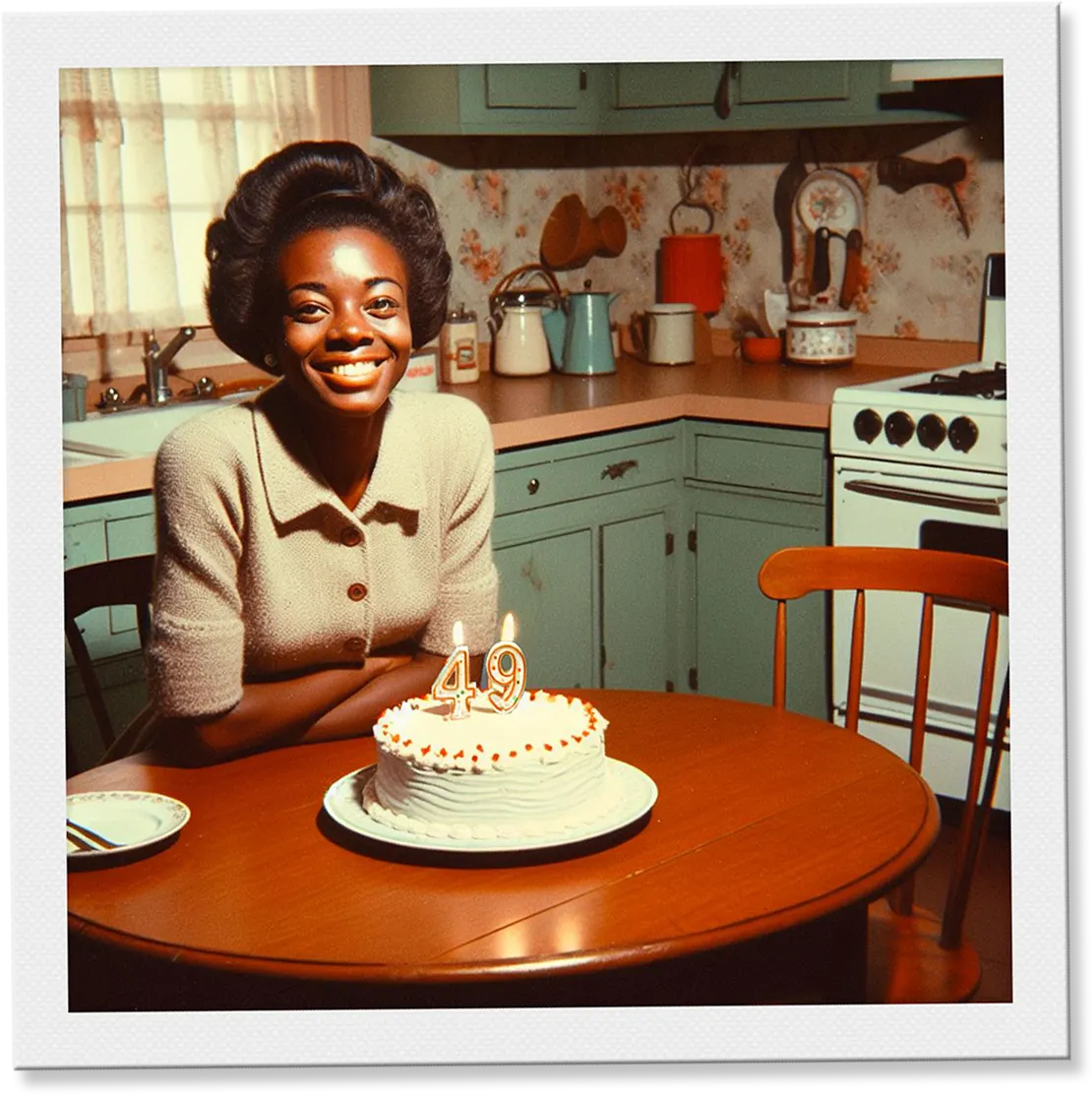
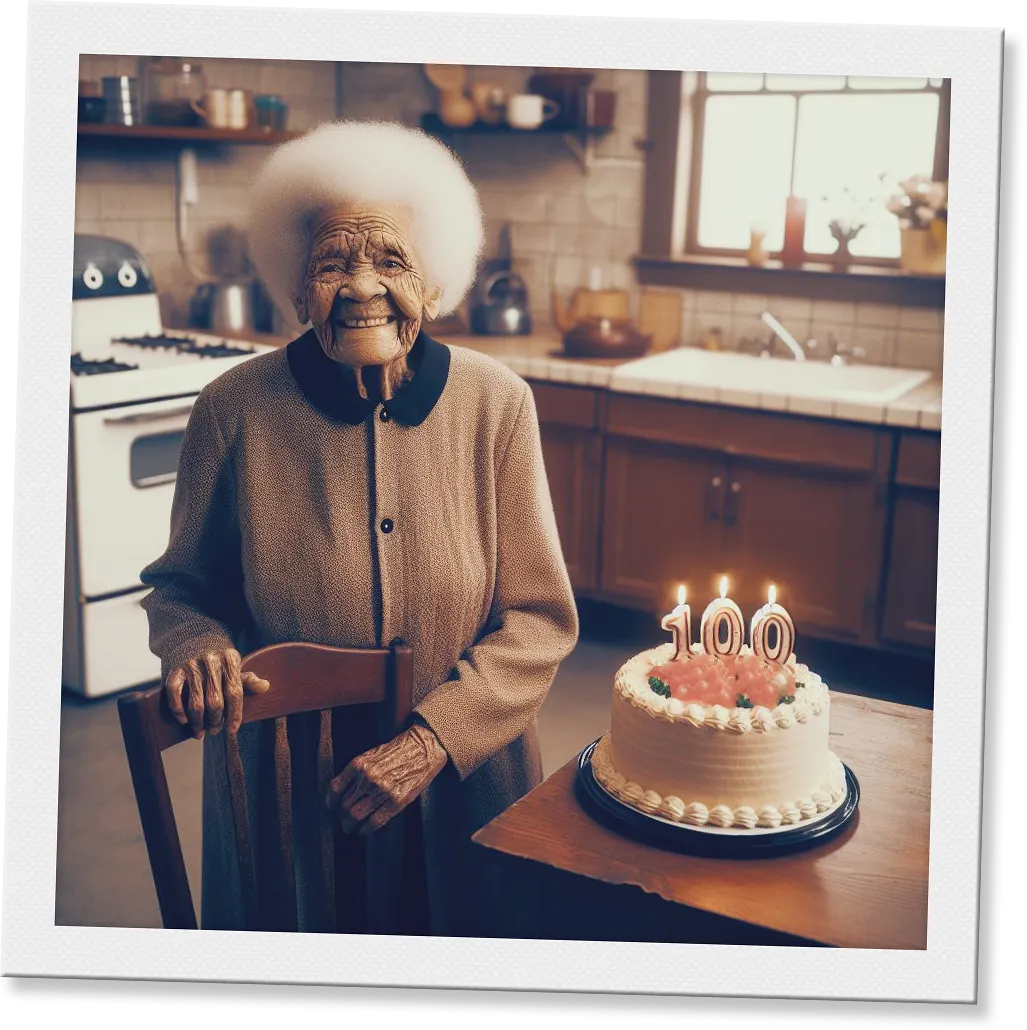
Elena whipped back to the house and saw the televisions glow through the window. No. That isn’t possible. I took the tape out. The thought sends her into the driver’s seat of her car. The engine was running. She only had to put it into drive, but Elena stared at Odetta’s photo album instead. Her breathing ratcheted down, then caught in her throat as an insane realization caressed her and left her shivering. She opened up the photo album and skipped past the short life of Yolonda to the empty celebrations. She pulled a photo out of Odetta sitting alone in front of a cake, turned the picture around, and groaned at the caption: ‘Eugene’s 49th Birthday. 1964’ She flipped ahead several decades and stopped at another photo of Odetta and a cake with three candles shaped in the number, ‘100.’ ‘Eugene’s 100th Birthday. 2017’
Odetta’s last words returned, bearing the crushing weight of understanding: ‘Some so silly they stick around.’
“Jesus Christ, all those years… you weren’t alone at all.” Elena’s gaze returned to the empty house as a deep need that never entirely went away welled up inside her.
But with Odetta gone, whatever was inside watching a kid’s show was all alone now.
The thought propelled her inside, and she tried not to think of the absurdity of what she was doing. She trembled as she took on a voice she hadn’t used in years but still fit like a glove. “Eugene? Honey, can you come here?”
She walked into the living room and saw nothing. As she reached down to stop the tape, she saw the boy again in the corner of her eye, peeking out from behind the kitchen door. Two black pits and a toothy grin one second away from a giggle. He disappeared the moment Elena tried to look directly at him. She sat on the couch and softly said, “It’s okay, baby. Come here.”
Nothing. Then, the pages of a children’s book rustled.
“Eugene, was that you?” Elena pulled out her phone and started recording. The book flipped over on its own. Goodnight Moon. It hurt to think how many times Elena read that to her son. The book shifted, then flipped over again, this time a foot into the air. It fell back down a little closer to Elena.
“Do you want me to read you a book, kiddo?”
The book scooted forward in response.
Working with the theory that, for whatever reason, the kid could only be seen by not looking at him, Elena kept Goodnight Moon in the corner of her eye and let her eyes go unfocused. There was nothing but a blurry book, and then she blinked and saw Eugene again. He sent Goodnight Moon flipping through the air with flailing arms, and then he was looking at her, silently giggling, stomping his little feet, and spinning around with his arms in the air in celebration. Eugene lost balance, fell on his ass, and immediately got up again. The kid couldn’t be more than one, maybe one and a half.
Elena replayed the video on her phone and watched Goodnight Moon flip through the air. It left her wondering if you could record and then replay moments of a mental breakdown. She honestly didn’t know.
A stuffed rabbit at the other end of the couch fell to its side and began to move as Eugene pulled it by the ear in fits and starts towards Elena. It was ancient, sown from corduroy long worn smooth. Odetta had stitched and fixed it so many times it was almost more patch than rabbit. Elena picked the stuffed animal up and squeaked as a soft warmth moved across her thighs and nestled underneath her arm. Eugene laid his head on her chest, and it came as pressure on her breast without weight or substance. With her other hand, Elena tentatively felt the space where Eugene lay and found the air was much warmer. Around 97.5 degrees, a child’s temperature, if she had to guess. She put the rabbit in her lap, and Eugene began to stroke it, leaving the stuffed animal looking like it was breathing.
Elena opened Goodnight Moon, and a tactile memory came of her reading to Mateo, his head resting on her chest, thumb in his mouth, softly giggling as his mother gave the characters silly voices. The page began to move on its own, and she saw Mateo reaching up with a finger, wanting to be the one in charge of turning the page. She tried to keep herself in that memory, but she ended up in St. Judes, reading to him as she had in the hospital bed. He was no longer giggling, just listlessly staring at the illustrations.
Elena wiped her eyes and pulled herself back to the present, where she held Eugene, the boy who wasn’t there yet still wanted to hear a bedtime story. She breathed in and began to read, “In a great green room, there was a telephone and a red balloon.”
Elena awoke to the sight of an unfamiliar popcorn ceiling, feeling oddly chewed out but not hungover. The previous night with Eugene already felt distant and unreal. She couldn’t shake the feeling that magic like that was fleeting. Oz only existed in Dorothy’s dreams. Then, a finger brushed her cheek, as light as a feather. Turning, she stared into the abyss, staring back at her.
Eugene was close, really close. She flinched, and he vanished again, leaving her to swallow her heart back down. “Sure,” she murmured, “I’ll spend another day in Oz.”
Rising, she rubbed her eyes, pondering that brief yet vivid encounter. It was the clearest view yet of Eugene. In the new day’s light, those black pits for eyes took shape into black orbs bursting with curiosity, and my God, he seemed so alive.
The cupboard began banging in the kitchen.
“Alright. I’m up. I’m up,” Elena said and shuffled out of the living room. She found a can of instant coffee next to a petrified cockroach, opened the fridge and found several jars of baby food. Each one had a date written on the lid and a curious collection of tally marks. She turned back to the open cupboard. “Wait… do you eat?”
A pink plastic bowl took a dramatic flip off the kitchen table.
“I’ll take that as a ‘yes.’”
Elena took out the mashed yams, wondering how feeding Eugene would work exactly. She presented the mush to the empty chair with the booster seat. “Uh, here comes the airplane?”
Eugene scraped the yams off the spoon, leaving two distinct marks from his front teeth. It splattered onto the rubber mat on the table. Elena picked up the plastic bowl and positioned it to catch the mess. “So you can eat…you just can’t actually ‘eat.’ Okay.”
She fed Eugene, wondering what exactly was going on. Was the kid actually hungry or just going through the motions? Could he even taste the food? Eventually, Elena just had to stop thinking about it. All the while, Eugene kept taking little bites while slapping the yams in the bowl, trying his damnedest to make a mess but only managing to leave behind little hand prints.
“At least you got some easy cleanup,” Elena said, “I’m not even going to pretend to know how to change your diaper.”
Not knowing what else to do, she scooped the yams back into the jar, added another tally to the lid, and returned the baby food to the fridge. Odetta spent decades living with Eugene. She must’ve figured out a thing or two. There had to be a system.
Elena felt a profound shift as her priorities began rearranging without her consultation. Suddenly, showing up to work on time seemed trivial. She played with the lid of Odetta’s Paul Malls as she called the hospice. The receptionist put her on hold, and she lit a cigarette with unpracticed hands. As her shift manager picked up, Elena took her first-ever drag and coughed her lungs out over the phone, managing to squeeze out the words “COVID” and “Just tested positive.”
Elena was given the week off, no questions asked, or at least she hoped no questions were asked. She stopped listening, watching the wisps of smoke dance around the shape of a boy. Perhaps this was why Odetta was a lifelong smoker.
“I guess I don’t have to worry about second-hand smoke with you,” Elena said, sending another puff toward Eugene. The outline pointed at the TV. “You wanna watch a movie?”
Eugene disappeared, and the smoke filled the empty space, confirming at least one theory on Elena’s growing list: Eugene didn’t need to walk. A lot of the time, he just appeared wherever he fancied. Aladdin began to slide out from Odetta’s VHS collection. Elena caught it and popped the tape in for him. With Eugene distracted, she took the opportunity to explore upstairs.
Odetta’s bedroom was a testament to neglect, with a tangible layer of dust and tar blanketing everything in a sticky layer. The master bathroom was littered with rat droppings, and Elena found the drowned remains of the culprit floating in the toilet. She flushed it down and winced at the rust-colored water that filled the bowl. The pipes were completely corroded. All of it painted a sad picture of a stubborn old woman living beyond her means and capability to maintain her home.
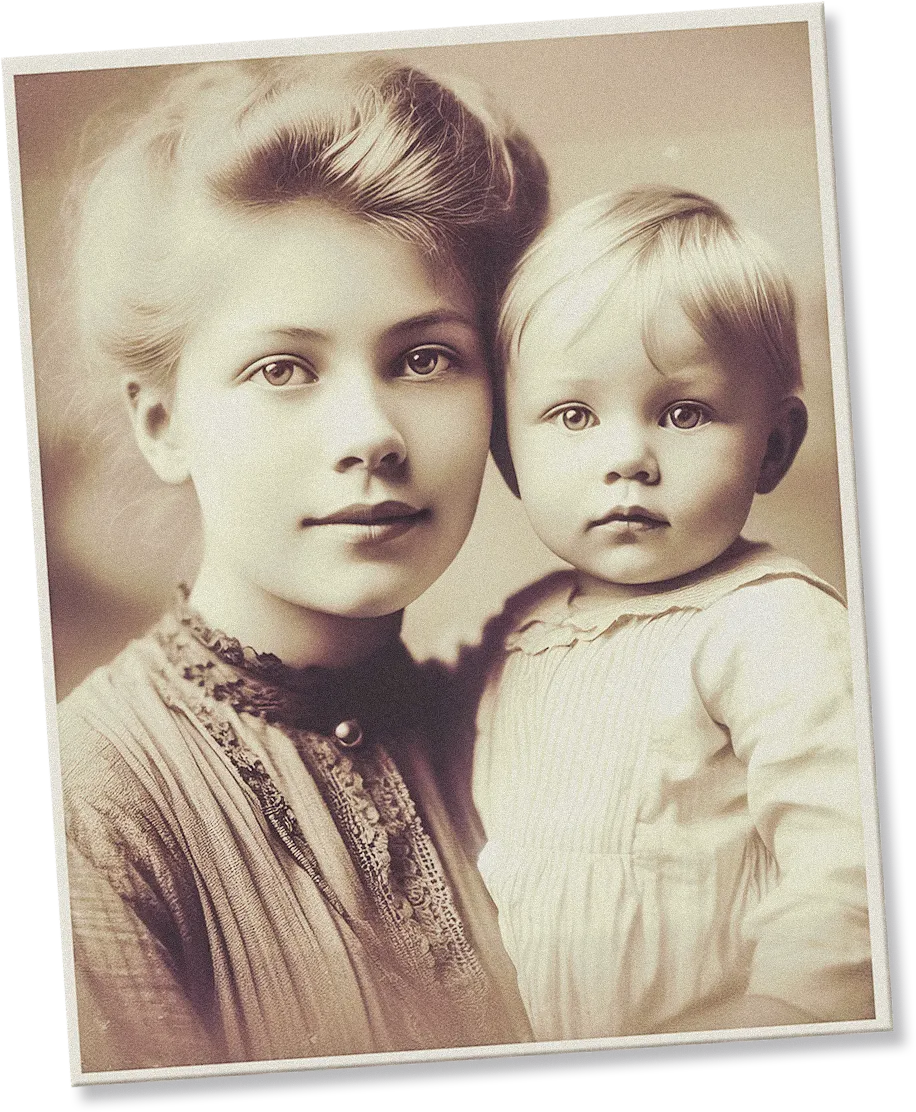
The second room was Eugene’s. He had a bed, but Elena wondered if Eugene ever used it. It was unclear if the boy actually slept or simply stopped moving. His assortment of toys was a chronicle of nostalgia spanning decades, and Elena had binged enough Storage Wars to know it was a gold mine. A framed photograph caught her eye. She picked it up, murmuring, “Oh my God.” It was Eugene, back when he was flesh and blood, sitting with his mother, holding his stuffed rabbit. The photo was old — Like before they invented smiling old. Elena popped off the back and found Odetta’s handwriting. ‘Eugene & Momma #1, Abigail Thomas, 1917.’
Elena went downstairs, her mind teeming with questions. She began digging through the internet, working around Eugene, who developed a fascination with her phone and started swiping up and down the screen. His tapping ceased when Elena stood and moved out of reach, which led to a peculiar realization: Eugene couldn’t float.
“Cross that one off the list of stereotypes,” Elena said, then stopped and creased her brow as she played that out. Wait, If he’s tied to the ground, does that mean he’s subject to gravity? Who decides what physical laws apply to him? The logic was baffling.
Elena’s research quickly bore fruit, thanks to an ancestry website. Abigail Thomas, born in 1898, married Nathaniel Thomas in 1915. They moved into this house, and soon after, Nathaniel left a pregnant Abigail to fight and die in the obscure ‘Banana Wars.’ A quick diversion down Wikipedia informed Elena that the conflict wasn’t as cute as the name suggested. The only traces of Eugene’s existence were his birth certificate, followed by his death certificate, issued fifteen months later. Influenza was listed as the cause of death, and a hyperlinked note pointed out that this was the most commonly listed cause during the Spanish Flu epidemic.
So Eugene died when he was only fifteen months old… 108 years ago.
“What do you do with a fifteen-month-old — ” Elena caught herself, hesitant to use the g-word. Acknowledging it would mean accepting that a ghost toddler was texting her former mother-in-law gibberish from her lap. It was simpler to think of him as Eugene.
What little Elena learned about Abigail was explained by Eugene being Eugene. Abigail never remarried and lived in the house until she died in the late 1950s. She must’ve been here all that time, still caring for her son. After her passing, the house changed hands twice, with no owner lasting more than a year.
Elena snorted. ”Oh, the realtor didn’t mention that Eugene came with the property?”
By the early 1960s, the racial makeup of the neighborhood had changed, and Odetta moved in 1964, three years after her own daughter was taken by a hit-and-run. She then spent the next sixty years taking care of Eugene.
And now what?
Elena found herself cleaning, wondering aloud about what she was doing. The kitchen was particularly challenging, not only due to the years of accumulated dust and neglect but also because of Eugene’s antics. Roaches lurked in every dark corner, ready to skitter out and startle Elena, and they had a tendency to explode if they stayed out in the open too long because Eugene loved stomping on them. Eugene also found endless amusement in the rolling mop bucket, splashing the muddy water, crashing the bucket into cabinets, and sometimes just flat-out trying to tip the whole thing over. Elena was at a loss about how to stop him. She couldn’t exactly pick him up, and drawing a circle of salt around the bucket only served to provide Eugene with something else to create a mess with.
It was purely by chance that Elena stumbled upon a solution to manage Eugene’s boundless energy when she closed the kitchen door to tackle the grime hidden behind it. Only after noticing the door rattling did it occur to her that she was finally alone. Elena opened the door, and instantly, the mop bucket began rolling away from her.
“You can’t move through walls? Seriously?” She mentally struck another spirit stereotype off her list and pulled back the mop bucket. “Maybe it’s a line-of-sight thing, and he can only pop up in places he can see.”
Elena spent the entire day cleaning until she could confidently say she was the dirtiest thing in the house. Her scrubs smelled — she smelled. Elena had no other choice but to head back to her own apartment, leaving behind a promise to Eugene that she’d return soon. Elena sped the entire way, plagued by the guilt of leaving Eugene alone, even briefly. She kept wondering why she felt solely responsible for his care but couldn’t find a satisfactory answer.
Back at her apartment, she showered and packed an overnight bag that was quickly traded out for her suitcase for week-long vacations. Again, she mused, “So you’re just going to live in a dead woman’s house, is that it?”
Elena didn’t give an answer. She swiftly returned to Odetta’s house. Excitedly walking through the door, she called out, “Eugene, I’m back!”
Silence ticked by, and fear and worry welled up inside. Perhaps leaving the house somehow broke the spell, and Eugene was gone. Her lower lip was trembling. She swallowed and tried again. “Eugene?”
Two arms wrapped around her thigh in a hug, and Elena stopped asking questions after that.
She had her answer: Everything she was doing was for Eugene.
Elena lost track of the days as she cared for the child that wasn’t there. All the while, she learned Eugene’s many idiosyncrasies. For instance, Eugene couldn’t feel pain, as evidenced by the time Elena caught him casually sitting on the open oven door, picking the pepperoni off a scalding hot pizza. Both dogs and cats could sense Eugene. Dogs went wild whenever they walked past Odetta’s house, but cats were a different story altogether. For whatever reason, the strays loved to sneak into the house and fall asleep inside Eugene’s space, treating him like a supernatural sunspot.
As Elena’s time with Eugene wore on, she discovered that stimulation was the fuel to his existence. Left alone to his own devices, the child would eventually grow bored and disappear. The realization allowed Elena to return to work without worrying about leaving him unattended, and the five-day staycation inside a dead woman’s house evolved into an indefinite arrangement.
Elena only returned to her apartment to shower and do laundry. She spent every second she could with Eugene. Every night, she fell asleep in Odetta’s room on her own mattress, feeling Eugene either in her arms or pressed against her back. Every morning, Elena woke up to Eugene either jumping on the bed or poking her in the nose.
It all seemed like a surreal blur as the days became weeks, which rolled into months, until reality woke her up with a sign in the front yard, and she realized how short-sighted she had been. No one raised a red flag when she started paying Odetta’s utilities with checks written in her name. There was never a knock on the door from someone questioning if she belonged there, and Elena didn’t question it herself. Being with Eugene, she felt complete for the first time in years. If anything, Elena figured the house had simply fallen through the cracks.
But behind the scenes, bureaucratic machinery had quietly churned ever since Odetta’s passing. Greased by capital and fueled by private interests, the process moved forward at a quiet and relentless pace. The bank holding Odetta’s debt swiftly moved to foreclose on her property, efficiently navigating probate with other creditors. They bypassed escheatment and public auction, opting for a pre-arranged private sale to the neighborhood developer. The developer, in turn, had every necessary permit rubber-stamped to remove the last remaining holdout to their vision of a “modern urban living community.” When it was all said and done, everyone patted each other on the back because they had cut the time it took for the county to address an “abandoned property” in half.
While Elena was at work, they arrived and claimed their victory, planting their flag in the form of a blown-up stock photo showing a hip twenty-something interracial couple laughing over ice cream and the words, “Benny’s General Store & Artisanal Creamery… Coming soon.”
A notice was stapled to the front door. In fifteen days, men were coming to tear down the only home Eugene had ever known to build an upscale bodega in its place.
Elena walked through the door, holding the notice in her trembling hand, feeling numb. A crayon moving back and forth over construction paper abruptly dropped and rolled across the coffee table. A second later, Eugene silently greeted her with a warm hug, his tiny arms wrapping tightly around her legs. He tugged on her fingers and guided her into the living room to look down at his drawing. It was just a scribbled mess of crayons on paper, but that was beside the point. Through her tears, Elena saw Eugene’s blurry, innocent face looking up, oh-so-proud of his creation, and the shock that had engulfed her began to recede as a cruel new reality started to set in: Eugene had no idea his days were numbered.
To be continued…
So goooooddd. I am excited for the next part. You did a fantastic job with the audio. I can only imagine how long that took. Thank you for sharing. 🦋💚
“In a quiet room that smelled of antiseptic, musk, and death, Odetta Brown lay taking shallow gasps, surrounded by hand-me-down flowers. Her black skin, pale and jaundiced, lay draped over bones. The dim light deepened her cheeks into pits.”
Instantly pulled in, and deeply immersed in this piece! It pulls on your heartstrings. This was so beautifully written! 🧡