

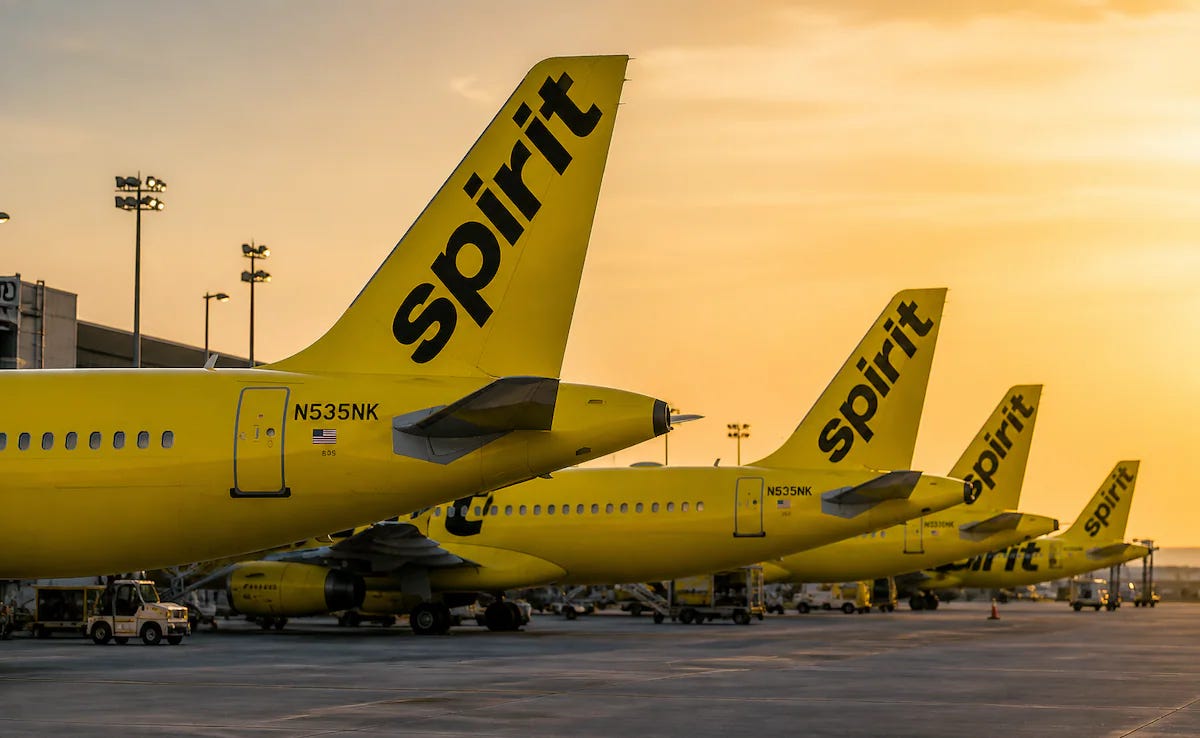
Spirit Airlines has officially shut down, beginning what it called an “orderly wind-down” of operations on May 2, and comedians all around America are mourning the loss of their favorite punching bag.
They want you to believe the airline’s collapse follows failed rescue talks and a second bankruptcy filing in under a year. They blame rising fuel costs and decreased air travel for overpowering their razor-thin margins. But you know what I say? It’s all a cover-up for the truth.
I have a theory. Not a good theory. Not a theory I would share under oath or near someone wearing a blazer. But I know it in my gut to be true:
Spirit Airlines was never really an airline. It was a marketing scheme cooked up by the airline cabal. From the very beginning, it was meant to be a joke. Think about it. What company chooses the same color scheme as a caution sign? Every time one taxied past the window, your brain didn’t say, “Vacation.” It said, “This cheap motel room smells like bleach for a reason.” But the true punchline of every lazy late-night joke about Spirit Airlines wasn’t Spirit Airlines—it’s that we were actually falling for their PsyOp.
Spirit’s purpose was simple: Their flights weren’t actually designed to be flown. They were only meant to be considered. You would open Google Flights, see a Spirit ticket for $79, and briefly experience the thrill of maybe, just maybe, finally finding something reasonably priced for once.
But from the jump, their flights are almost certainly algorithmically designed not to work with your schedule, offering Wednesday flights for your weekend trip, or a departure so early you’d have to stay up all night just to make it to the airport. Sometimes, they’ll just give you three connecting flights, turning a four-hour flight into a day-long marathon, and you’re stuck trying to make sense of how three flights bundled together are somehow cheaper, or why one of them has to take you halfway across the country in the opposite direction.
All the while, you see a direct Delta flight for $286 with a leisurely 10:00 AM boarding time on the exact day you want. Tempting, but far more than you wanted to pay.
So you start trying to make the Spirit flight work. But there’s a bait and switch to their à la carte pricing. Spirit is like a Chinese restaurant tempting you with $1 chicken fried rice, but when you pick it up, you find out the container isn’t included. That’s $4 extra. What are you going to do, walk home with two fistfuls of hot, greasy rice?
If you want to choose your seat, that’s extra. If you want a vague promise of even having a seat, that’s also extra. A carry-on bag? Extra. Leg room? Extra. Oh, and did I mention this is all per-flight, for both departures and returns, and each individual connecting flight involved? By the time you’ve finished adding what amounts to the bare minimum on any other airline, you’re sitting at around $220.
Now you’re staring at that direct Delta ticket for $286. Suddenly, it seems almost reasonable. Which is the entire point.
That was Spirit Airlines’ true function in the ecosystem. They were a front secretly propped up by the rest of the airline industry to make every other carrier look like a premium experience by comparison. Not because Delta, United, American, or Southwest are especially good — let’s not get hysterical — but because they weren’t Spirit.
Spirit also strategically lowered the bar, shifting the Overton window on what counts as an acceptable flying experience, so the other airlines could profit off being their worst selves. Every time some insane, stingy airline scheme made headlines, it was either Spirit piloting a new way to make your life miserable, or a major carrier adopting a lighter version of what Spirit had already normalized.
You know how airlines now vary the price of each seat so you’re forced to pay more if you want to sit together as a family, or not have your face jammed against the bathroom wall? Would you actually be surprised if an exposé revealed that it was a coordinated industry effort, and they sent Spirit, the resident clown, to test consumer reaction first?
I wouldn’t be. And not because I’m the one who just completely made up this hypothetical.
But here’s where the grand conspiracy broke down: For this scheme to work, people have to be able to afford the alternative, and the alternative has to have enough perks to justify the higher price tag.
Spirit was useful to the airline industry as long as it stayed a big yellow warning sign, frightening customers back toward the legacy carriers. But in this economy? When the rent went up, and the local crack house started to have curb appeal, Spirit Airlines became Max Bialystock in The Producers, foiled by its own success. The math got ugly enough, and flying got so miserable and expensive, that its signature brand of stingy misery actually became competitive.
And now, in a time when we need a cheap option the most, Spirit is conveniently gone.
…Almost as if by design.
I’ve never been more convinced by a conspiracy theory in my entire life.
I’ve also never met anyone who has actually flown on Spirit.