

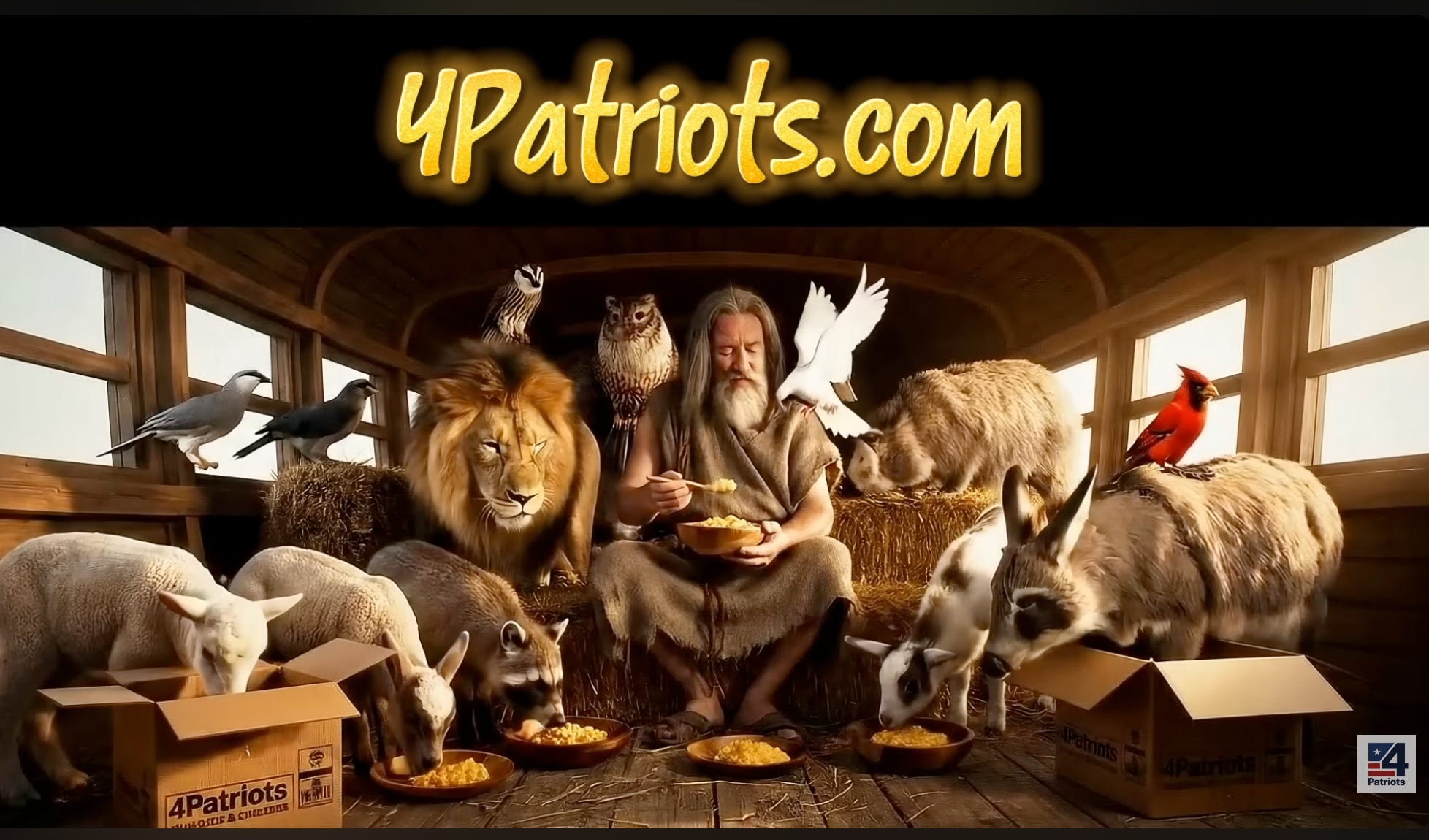
A while back, I had a full-blown existential crisis inside a Shell station. Under the hum of fluorescents, a tiny TV behind the counter cut to a 4Patriots commercial, and it was the first time I’ve ever seen an AI-made ad in the wild.
Let me repeat that, because the absurdity of it is insane: A company selling doomsday prepper chow ran a spot built by one of the robots currently taking over the world.
In it, Noah gives a TikTok-style tour of his uncanny-valley ark. Everything’s a little too saturated. Noah’s forehead looks airbrushed, and his face drifts between shots like the model can’t decide whether he’s Boromir or The Dude.
And the final shot is a veritable eye-spy of AI hallucination. Noah only has four fingers. The 4Patriots boxes contain “Mærgęr0nie & CheiDRS.” One bird is floating in thin air, and the creature on the right looks like an evolutionary ancestor you’d see at the Smithsonian that would inevitably become donkeys, pigs, and raccoons.
I did the reflexive “wow,” then it hit me: That all-too-common panic of being the ox meeting the farmer’s brand-new tractor.
AI commercials might be hawking buckets of survival beans at 1 a.m. now, but it’ll become the industry standard in a few years.
AI video may never win at long-form filmmaking. Every time I see some flashy action-packed slop showing that Hollywood is “Cooked”, my first question is: Okay, now can you make the AI show those same characters having a simple back-and-forth conversation? Don’t worry, it’s the first thing they teach you how to shoot in film school. It should be easy, right?
Almost immediately, Hollywood becomes less “cooked” and more “cooked Al Dente.”
The Ad industry, though? Oh, they’re cooked.
Let’s start by stating a painfully obvious truth for anyone outside of the Ad Industry, but is complete heresy even to hear if you’re on the inside: No one likes ads. I know you have to believe you’re Andy Warhol, not some guy shilling Campbell’s soup to avoid a full-blown existential crisis, but I’m sorry, it’s true. No one likes ads.
No one is paying to watch your commercial. In fact, many are willing to pay extra just to skip your ad entirely. Watching a commercial is traditionally the price you pay to watch something else.
When it comes to our eyeballs, ads carry all the consent of a park flasher. Marketers know the best kind of audience for a commercial is a captive audience. I’m pretty sure the only thing stopping Charmin from grabbing people off the street and keeping them in a dark basement pit where the Charmin Bears tell them, “It watches the Ad, or it gets the hose again,” is that an agency has yet to it pitch to them as ‘viral guerrilla marketing.’
All this is to say that the bar for commercials is already abysmally low. Nobody likes being sold something, and for those within the Industry, the only palatable quality of an ad campaign is that it at least tries to be memorable.
It also doesn’t hurt that working in the Ad Industry pays well. It’s a solid place to find a middle to upper-middle-class job.
Or at least, it was. The moment that an AI’s pennies-on-the-dollar and speed become a viable and noncontroversial option, the entire independent Ad industry will fall, taking with it all those middle to upper-middle-class jobs.
In terms of a medium, you cannot find a better opportunity for AI video to take over than a commercial. A commercial, at its core, is just a few seconds of screen time that hopefully lingers in your consciousness long enough that you decide to buy something when the opportunity arises, and AI is already capable of creating videos that run only for a few seconds. They only have to be “good enough” to erase an entire production crew’s call sheet.
And that’s what people mean when they say AI is about to “Cook” some industry.
A perfectly normal 30-second spot is expensive to shoot, and that cost climbs fast the second you ask for anything beyond “people talking in a kitchen.” If you shot a Noah’s ark commercial the old way—even the scrappy version—you’re wrangling wardrobe pulls and prop builds, day players and animal elements, a director, DP, AD, a small grip-and-electric crew, script sup, sound, makeup, then off to editorial, color, mix, and FX. Run it on duct tape and favors, and it’ll still coast past five figures.
Now the AI version? It’s one person at a laptop with a stack of prompts, rolling the dice, hitting ‘generate’ until they get the shots they need. That’s it. Maybe you keep some post-production people to edit it together and clean it up, but the prompt monkey could probably handle that, too. With CapCut. On their phone.
Put those two productions side by side and tell me which one is left standing. And how long do you think the old Ad Industry is going to last with all their former clients leaving them on read?
The scariest part is how indirect it all is. Maybe you could argue that basic human decency will stop your local Mom & Pop multinational from axing entire departments outright. But what about the third-party vendors? People get canned every time an ad agency loses a client. The corporation doesn’t have to fire anyone for hundreds of jobs to disappear. They just “go in another direction,” and the bodies pile up somewhere else. Not to mention that many of those same agencies are scrambling to stay relevant by rolling out their own job-cutting AI tools.
Is that depressing? Yes. Is it stoppable? No.
It’s not just doomsday-prepper-chow making AI commercials. We’re already seeing Coca-Cola and Super Bowl commercials bite the AI-generated bullet.
The brutal truth is that the spreadsheet is a wrathful God and it’s already made up its mind. Noah’s ark has already set sail, and the Great Flood of AI Slop is upon us. So what can you do about it?
Maybe you can join the growing social backlash to anything related to AI. That might work at first, at least while you can still single out companies that give in to temptation, not so much when those offending are the majority of the S&P.
You also have to keep in mind that the greatest enemy of any protest movement isn’t the entity being protested; it’s normality, inevitability, and time.
I think back to all the backlash EA received for its early attempts at DLC and loot boxes for Star Wars Battlefront 2. Did the protests work? Yeah, we “won” that fight. And now we all pay for season passes to play the game we already bought. Hell, most modern games make Battlefront 2’s ambitions to print money look quaint.
Maybe you can stand by your principles. Ask “What Would Don Draper Do?” Then argue about taste, craft, and the soul of advertising. I give it about 30 seconds before people start snickering because you’re unironically defending the integrity of a commercial. And that’s just for a room full of people who work in the ad industry.
When consumers draw the line, it won’t be for the sanctity of ads they already don’t like to watch. As long as AI doesn’t taint their viewing experience, it’ll be fine. Which is to say, it won’t be fine. AI is almost certainly coming for their TV time as well, but that only means they’ll have to choose their battles.
Ultimately, the studios are putting all their money on AI reaching a point of normality where the term becomes as interchangeable as CGI (with the unspoken added benefit of completely replacing the thousands who create CGI for a living)
As a copywriter, I was hit by that initial wave of AI innovation. After all, why go through the effort of emailing a copywriter, setting up a call to walk them through the brief, then waiting several days to receive a packet, when you can just copy-paste that brief into ChatGPT and hit Generate? The human is single-use, takes forever, and costs lots of money. The AI only requires a monthly subscription.
Well, I would argue that the LLM lacks quality and originality, but I can already hear the snickering. Again, we’re talking about commercials. Instead, I’ll just focus on the one thought that kept me from having a complete doom spiral:
I eventually pulled myself together, realizing that I could’ve made that dumb Noah’s Ark video myself.
I’m a creative copywriter. My job isn’t just to write words gud, but craft entire concepts. I already have a decade’s worth of experience writing prompts to describe action, tone, blocking, framing, wardrobe, props, and performance, only I called them scripts.
That kind of job doesn’t have to disappear if it learns to mutate. The “Copywriter” just needs to swallow their pride, grow a new organ capable of digesting toxic AI slop, and start answering to “Promptwriter.”
Then, all I have to do is fight off the refugees of an entire fallen industry to be that one prompt monkey sitting at a computer, hitting generate.
At the very least, it’ll give me a few more years before AI comes for that job as well.