

Like all good stories, what started out as a simple investigation into a small, misunderstood town turned into a journey too dense to tell in one sitting. New Israel has been the gift that just kept giving, and I hope you enjoy it as much as I did.
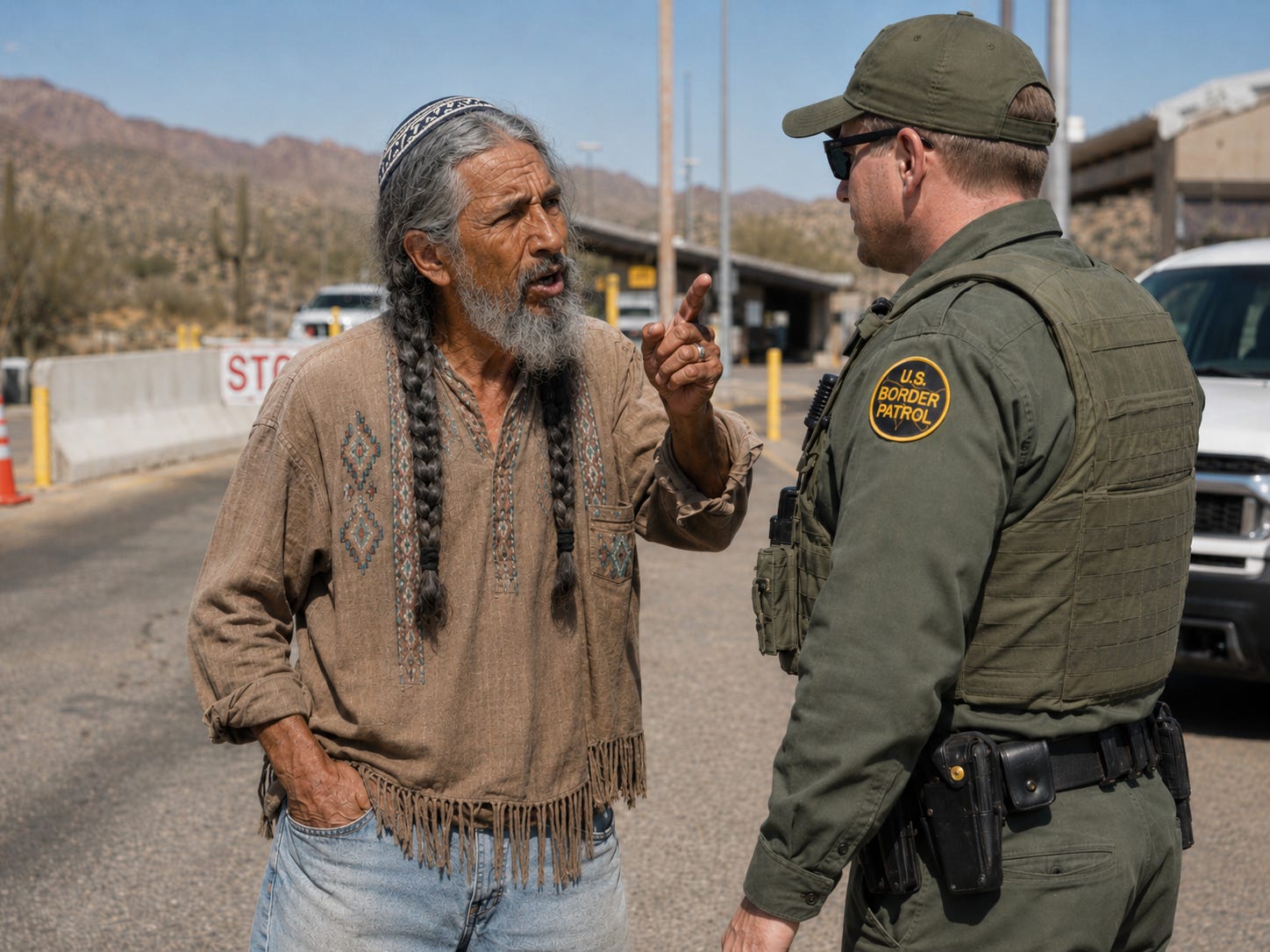
On the morning of the Israeli invasion, Rabbi Yazzie-Goldstein was standing at a makeshift checkpoint, arguing with a border agent over whether a shipment of lemon trees constituted agricultural contraband.
The trees had been ordered for Sukkot and had come from a nursery less than three hundred miles away. They were presently wilting in the back of a pickup truck stuck in a long line of idling vehicles waiting to cross.
Each car had to be thoroughly inspected from top to bottom, passed over by bomb-sniffing dogs, and swabbed for chemical residue. Every bag and container was unpacked and rifled through, then left on the ground for civilians to repack. One Border Patrol agent tossed a jar of baby formula into a dumpster, then consulted his supervisor about a baby bottle full of prepared formula.
Every civilian’s ID had to be checked. Phones were unlocked and scanned. Facial-recognition software and Palantir background searches combed through social media for any hint of extremist leanings. If something didn’t check out, no matter how slight, the traveler was turned away.
“We’re in Arizona,” Rabbi Yazzie-Goldstein pointed out.
The agent consulted a clipboard. “No, you are on the border of a U.S.-sanctioned terror state.”
“Inside Arizona, a U.S. state!” the rabbi shouted. He took a breath and tried to reason with the man. “They’re just lemon trees. What’s so bad about lemons?”
“You know how they say, ‘When life gives you lemons, make lemonade’? Well, lemonade concentrate mixed with gasoline can also make napalm.”
Yazzie-Goldstein stared dumbfounded at the agent.
Later, he would look up the claim that lemons could be weaponized. The closest thing he could find was a fictitious napalm recipe recited by Tyler Durden in Fight Club, and that involved concentrated orange juice.
“This has to be against the Constitution,” Yazzie-Goldstein pressed. “You know, the whole thing about interstate commerce.”
The agent wasn’t listening. Orders were being squawked into his earpiece. He looked past the rabbi toward the low adobe buildings of Little Tel Aviv and the ochre hills beyond, then sighed.
“Sir, I would say take it up with the Supreme Court, but you’re President Netanyahu’s problem now.”
The rabbi sputtered. “President who? What?!”
A rumble came from down the road, the shimmering Arizona heat rising from the asphalt, masking something massive coming their way.
The agents sprang into action, hastily directing as many civilian cars as possible away from the checkpoint, then forcibly pulling drivers from vehicles that had become boxed in.
All Yazzie-Goldstein could do was watch as the head of the IDF convoy, an armored Caterpillar D9 bulldozer, smashed into the pickup truck containing his ceremonial lemon trees, reducing it to twisted steel and pulp.
A hundred APCs and support vehicles followed. Within an hour, an armored vehicle was parked beside the organic grocery co-op, and two soldiers were unrolling concertina wire across the entrance to the weekly farmers’ market.
Israel’s invasion of New Israel had begun.
Rabbi Barry Yazzie-Goldstein, locally known as “Rabbi Yaz,” is a lean, tan man with a long beard and even longer braided hair. He is, in his own words, a “sun-dried hippie.”
Barry was born in 1961 at St. Joseph’s Hospital in Phoenix to Miriam Goldstein, a Jewish social worker from Queens who fell in love with the state of Arizona, and Thomas Yazzie, a local member of the Navajo Nation. Thomas was a simple man who repaired air conditioners and generally distrusted almost every organized religion.
“Except the Jews,” Rabbi Yaz explained. “The Navajo never had to worry about a Jewish missionary. In fact, my father deeply appreciated how aggressively okay they were with him not converting.”
Rabbi Yaz has always taken pride in belonging to two tribes. He grew up celebrating Passover in the spring and attending tribal gatherings in the summer. Wherever he went, he was surrounded by relatives who disagreed about nearly everything except the importance of feeding him.
“Put the two together and you get brisket Navajo tacos. You can’t go wrong there,” the rabbi said, motioning toward a popular local food truck run by his youngest son.
At twenty-three, after studying comparative religion at Berkeley, he entered rabbinical school. He emerged with a beard, a wife named Naomi, and an enduring suspicion of anyone who described history as destiny.
“I’m not anti-Zionist,” Yazzie-Goldstein quickly pointed out. “I protested South African apartheid in the eighties, sure. And, yeah, maybe there are some parallels, but—”
The rabbi stopped walking and shook his head. “Did you see the Knicks last night? Let’s talk about that.”
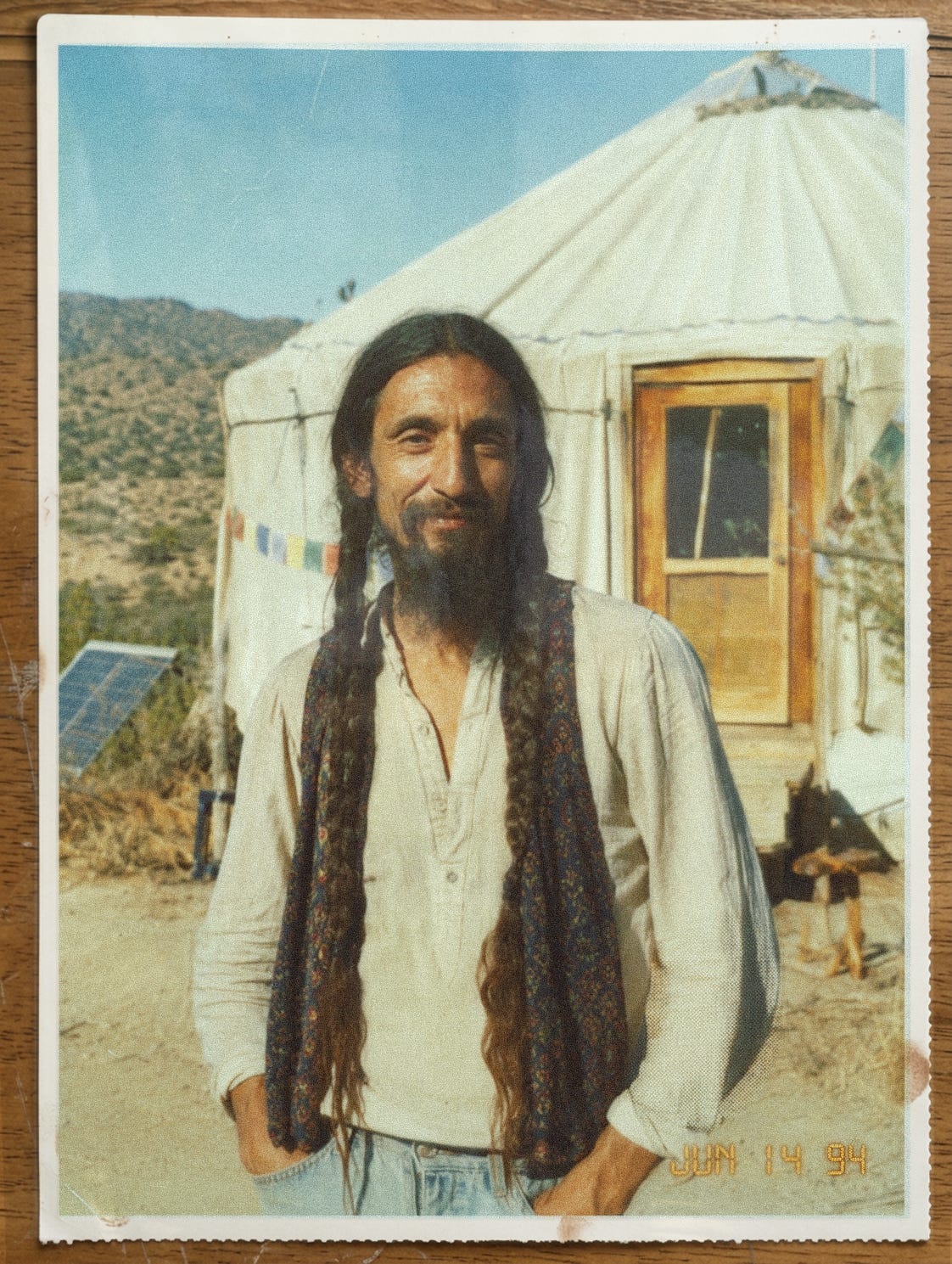
When Thomas Yazzie died in 1992, Rabbi Yaz inherited stewardship rights over a vast and largely undeveloped tract of tribal land in the Sonoran Desert. The property consisted of several thousand acres of rock, scrub, and abandoned cattle fencing. Its most valuable asset was a decaying roadside attraction called Tiny Holy Land, a Bible-themed miniature-golf course with a fiberglass Mount Sinai, a miniature Temple of Jerusalem, and a ten-foot-tall Tower of Babylon. The land had little commercial value. It was far from the interstate, even farther from reliable water. One appraiser described it as “a beautiful place to die from sun exposure and dehydration.”
Rabbi Yaz regarded this as a challenge.
The commune began in the spring of 1994 with twelve adults, three vans, and one portable generator. After an evening involving several bottles of Manischewitz, marijuana, and mushrooms, Rabbi Yaz penned a document called “The Covenant of the Thirteenth Tribe of Aquarius” and christened the land New Israel.
The name was deliberately grandiose. Yazzie-Goldstein intended it to represent the construction of a civilization in the desert.
“But we weren’t founding a second Jewish state with our little settlement,” he later joked. “We were founding, eh... maybe Palm Springs? Let’s go with that. We were founding an even Jewier Palm Springs.”
Its first residents were all friends of Yazzie, and in his own words, “some variety of dirty hippie.” They lived in yurts and converted school buses while building adobe houses by hand. Electricity was intermittent. Water arrived by truck twice a week.
As New Israel gained popularity, the modest commune grew into the quaint, unincorporated town of Little Tel Aviv. Its politics were aggressively progressive even by the standards of the nineteen-nineties. Queer couples were welcomed, and Rabbi Yaz performed their weddings years before most states were willing to acknowledge that anything legally significant had occurred.
Those marriages exposed an old cartographic problem that would come to define New Israel. While trying to secure spousal health coverage for gay couples, the commune’s resident attorney discovered that New Israel did not technically sit within the Navajo reservation at all. An eighteenth-century survey error, two contradictory federal maps, and a treaty boundary defined by a nonexistent creek had left the property in a jurisdictional blind spot. It was either Arizona or Navajo land, depending on who was asked, with each side assuming it was governed by the other and neither particularly confident it had been legally incorporated at all.
Rabbi Yaz had little interest in the discovery. From the beginning, he insisted that New Israel could exist only with the active participation of the Navajo Nation. It would be nice if insurance companies also took care of “Pam and Nancy with her bum knee.” Rather than fight the Navajo Nation in court, he pushed for formal integration and mutual recognition, effectively making New Israel a tiny Vatican city nested within the Nation, except with yurts and considerably better attitudes toward lesbians.
Or, in his own words, “Self-determination, but let’s not be assholes about it.”
In 1999, the Tribal Council approved a ninety-nine-year cooperative land agreement with New Israel, dubbed “The One State Solution.” What he did not fully understand at the time was how much authority the commune’s attorney had quietly preserved. The resulting agreement gave New Israel control over residency, local courts, policing, zoning, marriage recognition, utilities, and internal governance. Yaz had effectively gone looking for health insurance and accidentally secured the legal framework for a small country.
New Israel’s tax revenue would be shared. Navajo citizens could live, work, and operate businesses in the community without any additional legal hurdles, and the population quickly swelled to resemble everything Yazzie-Goldstein embodied: both Jewish and Indigenous, and entirely, frustratingly liberal. New Israel’s schools taught both Hebrew and the Navajo language. Its governing council reserved seats for tribal representatives, even when they chose not to use them. Some tribal representatives remained suspicious. Others found Goldstein amusing.
“He came in talking about two displaced peoples building something together,” recalled Lena Benally, who served as the community’s planning director. “It took me fifteen minutes to realize he was talking about constructing a place to get a good bagel and schmear.”
The rapid growth of New Israel was nothing short of a miracle. A hydrogeologist living at the commune identified a deep aquifer beneath the property. Solar arrays replaced the portable generators. A grant from the Navajo Nation funded a wastewater-recycling system. The community began producing dates and citrus, along with groves of olive trees, with Rabbi Yaz insisting, “We’re gonna be here a while.”
By 2003, Little Tel Aviv had paved roads, a health clinic, a synagogue, and a quaint main street. By 2014, that main street had evolved into a central pedestrian boulevard lined with palo verde trees. As the residential population ballooned to more than five thousand and tens of thousands of tourists began visiting each year, the old yurts that remained on the hill above town were converted into vacation rentals, and a BuzzFeed listicle named it number three on its list of “America’s Best Liberal Havens Inside a Conservative Nightmare Hellscape.” A major investment in fiber-optic infrastructure proved to be a godsend during the COVID pandemic, as remote workers flocked to the small town and bolstered its middle class. By 2024, Little Tel Aviv was a small city with several developing neighborhoods, a municipal water park, and a revitalized Torah-themed miniature-golf course.
The expansion was not without friction between New Israel and neighboring Navajo communities.
“New Israel has always kind of done whatever it wants, and the Tribal Council doesn’t stop them,” complained Melissa Begay, a resident of the Navajo Nation. “And I know they’re giving a large chunk of their tax revenue to the Nation, but it’s not like I’ve seen any of it.”
“They stopped a casino from opening right on their border,” claimed Nester Chee, another Navajo resident. “They said it didn’t support their town’s values, but I’m pretty sure they did some meddling and pulled some strings. They didn’t like not getting a cut because… you know…”
When we reluctantly asked him to clarify, expecting the worst, Nester replied, “They’re a disproportionately wealthy, semi-autonomous enclave with significant influence over the Tribal Council.”
He frowned. “What? Why do you look so relieved? What did you think I was going to say?”
“It’s a blessing that my boy gets to go to their charter school,” said Ellie Bitsilly, a local waitress and single mother. Her son attends Red Mesa Community Middle School, which strives to fill its classrooms with equal numbers of Jewish and Navajo students.
“But I swear, I’m taking him to some bar or bat mitzvah every weekend nowadays. He’s got a whole collection of monogrammed yarmulkes. The other day, I caught him singing, ‘Die, die, emu. Die, die, emu.’ I thought it was some silly Fortnite song, but he told me it was something for Passover, and I dunno…”
She shrugged and blew air through her lips. “For a Navajo school, it doesn’t seem very Navajo to me.”
Visitors often compared New Israel to Israel itself, but Rabbi Yazzie-Goldstein grew to dislike the comparison.
“Yeah, but Israel has the whole thing with Gaza and the West Bank. It’s—” Yazzie-Goldstein sighed. “Did you see the Diamondbacks last night? I’m starting to think this season might not be total shit.”
The comparison persisted. Then, in the wake of the war in Gaza, it became politicized.
“At first, we were getting tourists coming in to pick a fight with New Israel,” explained Edith Nez, a seventy-year-old member of the Navajo Nation and owner of a vegan ice-cream parlor. “They’d come in and shout, ‘End the genocide!’ and we’d shout back, ‘Yeah, no shit!’ Then they’d sit down, and we’d hand them some free sherbet and try to make them feel heard. Really, that’s all they wanted.”
Yazzie-Goldstein began to worry when he noticed tourists walking around in T-shirts that read “WELCOME TO NEW ISRAEL” on the front and “THE ‘GOOD’ ISRAEL” on the back.
He realized something had changed when tourists began lining up around the block for his son’s food truck.
“I’d never seen so many visitors in a single day,” he recalled.
The rabbi seldom used social media and was shocked when his grandchildren showed him the exponentially growing online conversation surrounding the town. TikTok and Twitter users were comparing New Israel’s decades of peaceful integration with the Navajo people to Israel’s displacement and oppression of Palestinians.
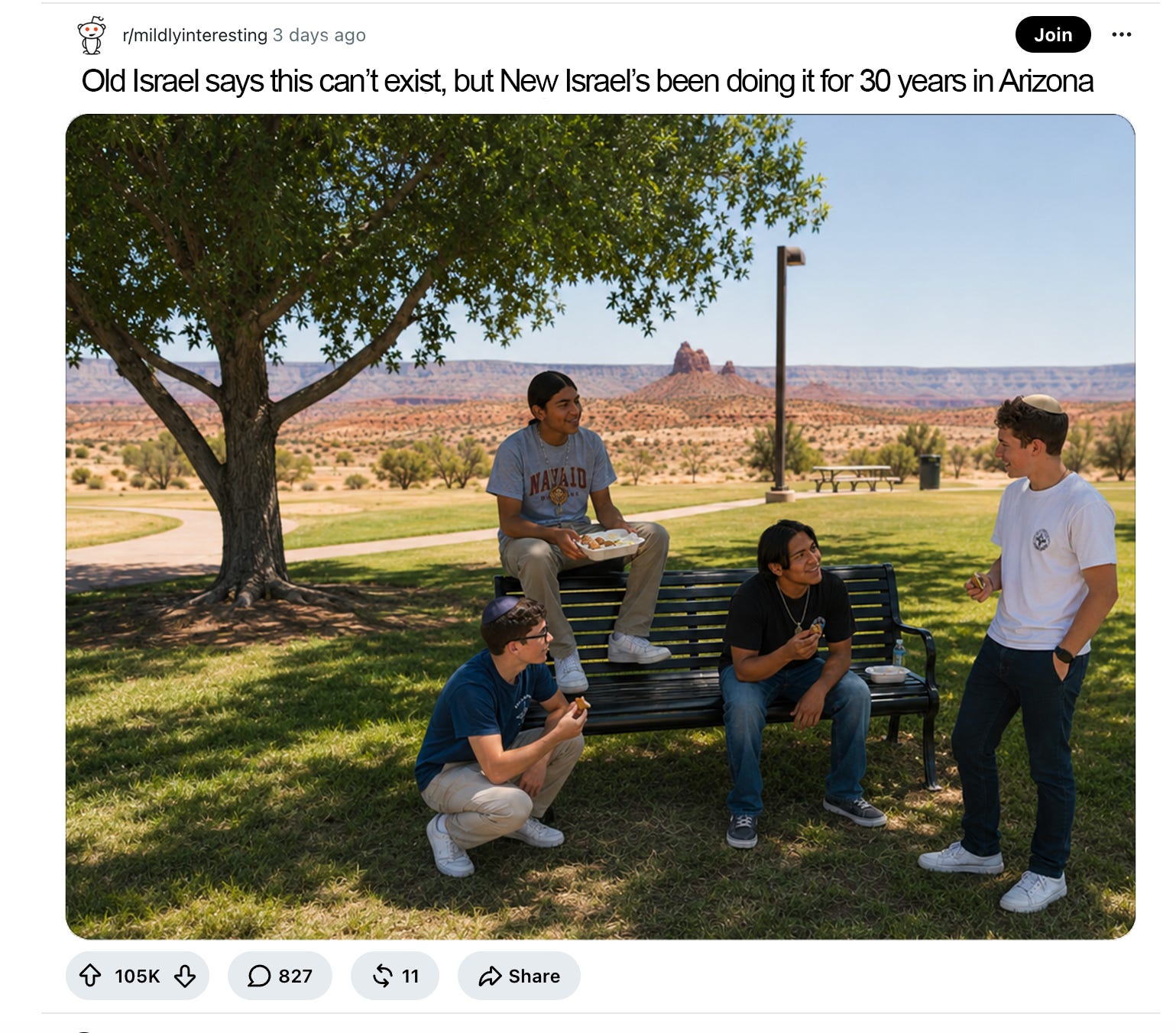
A candid photograph of Jewish teenagers in yarmulkes eating falafel with their Navajo friends became the platform’s top post for the week. Two posts below it was the popular Zoolander meme with the caption, “NEW ISRAEL IS SO HOT RIGHT NOW.”
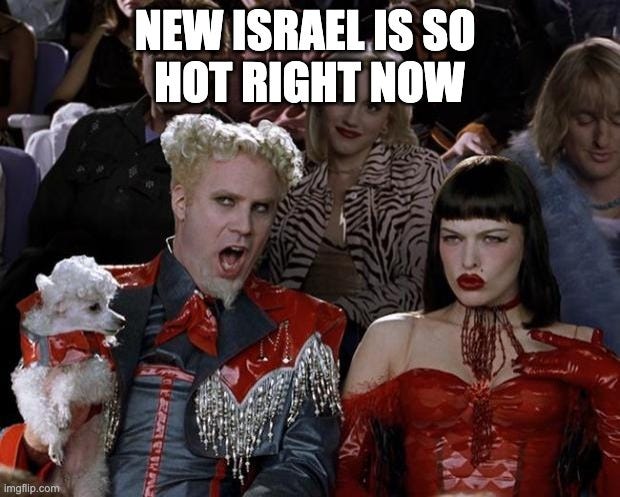
It seemed New Israel was gaining worldwide recognition for all the reasons it was not Old Israel, and much of the virality stemmed from relabeling Israel proper as “Old Israel.”
“It’s petty, and I kind of love it,” said one visiting UCLA student who asked not to be named. “You spend all that time arguing why what’s happening is wrong on ethical and moral grounds and get nowhere. It just feels good to devastate them with something like, ‘Oh, honey, those bangs aren’t working.’”
“I knew it was a real problem,” Yazzie-Goldstein said. “This is a town where people live, not a political statement about some fakakta ethnostate—”
The rabbi stopped himself. “Have you seen Caitlin Clark? Now that girl has some drive!”
Rabbi Yaz could not have been more right, though no one could have truly foreseen the international firestorm coming for his little oasis.
By the end of the month, Rabbi Yaz would be labeled a terrorist…
…and for the first time since Britain’s occupation of New York ended in 1783, New Israel would become the first city in the continental United States to be invaded by a foreign power.
TO BE CONTINUED