Read Part One, and find out how a $2-million-dollar book deal spiked over AI allegations spells trouble for debut authors and the publishing industry at large. Or don’t. This can be read on its own. You do you, boo.
There’s an obvious desperate need to know what’s inside mystery meat.
If I’m going to spend my time reading a novel, I’d like to know if a person actually wrote the damn thing. If I’m representing an author, I need confidence that they aren’t a fraud. Teachers need to know that students are doing the work. Platforms like Substack need subscribers to believe that the writers they’re financially supporting are legitimate. It’s the only way Substack can continue functioning as OnlyFans for victims of carpal tunnel syndrome.
Unfortunately, satisfying that need requires something we don’t currently have: A definitive AI detector. Instead, what we got was Dr. Pangram rolling into town with their Patented Cure-All Elixirs and Genuine AI detectors. All they’ve done is make the situation exponentially worse.
Pangram works by training an AI on enormous collections of text labeled “human-written,” “AI-generated,” or “human writing altered by AI.” It learns statistical patterns associated with those categories, then examines new writing and predicts which category, or mixture of categories, it most closely resembles.
And the key word there is predicts.
AI detectors do not detect machine authorship the way a breathalyzer detects alcohol or a Geiger counter detects radiation. Pangram isn’t finding hidden metadata or some forensic trace left behind by ChatGPT or Claude. (Or, at least, not yet. More on that later.) It’s just classifying prose according to patterns it has learned to associate with human and machine writing.
It’s looking at the text and asking which pile it most resembles: Human. AI. Or, “I dunno, maybe both?”
That’s far from definitive proof and about as scientific as phrenology. Hell, just reading this essay and taking an educated guess, you are doing exactly what their slop detector does.
Yet, Pangram wants you to treat their educated guess as if it’s an official certificate of authenticity. I’m honestly surprised they’re not selling physical copies of the results on cardstock with a gold seal.
This wouldn’t be as much of an issue if the society we lived in had any nuance, but AI-detector results are often treated as irrefutable proof. Pangram might be offering us a percentage, but so many of us are operating in a binary. A frowning robot face accompanied by “30% likely AI-written” can very quickly become “30% of this is AI,” which becomes “this author used AI,” which becomes “100% fraud. Fuck that guy.”
And simply looking at how quickly Pangram and AI-authorship scandals are expanding over time is galling:
March 19: Hachette pulls Shy Girl after Pangram founder Max Spero scanned the novel and reported it as 78% AI-generated.
May 13: Pangram 3.3 launches.
May 19: The Jamir Nazir scandal explodes as Pangram reports his award-winning short story The Serpent and the Grove is 100% AI-generated.
June: Pangram reports its monthly users have increased from roughly 2,700 to 120,000 over the past year.
July 21: Substack integrates Pangram, putting its AI scanner directly in front of readers.
July 22: Researchers submit a study analyzing 14,419 self-published books using Pangram. Roughly 37% contain at least some detected AI text.
July 27:The Atlantic reports on that study, spotlighting the novel Daggermouth, which Pangram classified as roughly 60% AI-generated.
July 29: Pangram 4 publicly launches alongside a $9 million funding announcement.
July 29: That very same day, Europa agency cut ties with Jerry Falade, a 20-year-old Nigerian PhD student who wrote Call Me, I’ll Hide the Body, a debut novel so compelling it launched a fourteen-way bidding war between major publishers.
July 31: Falade’s collapsed $2 million deal becomes major publishing news.
While Jerry Falade’s former agent, Marc Gerald, explicitly says they did not use AI-detection software when concerns arose about Call Me, I’ll Hide the Body, it makes absolutely no sense when you think about it, especially when you take what he told The Guardian.
According to Gerald, an editor had already raised concerns about possible AI use midway through the submission process. Europa considered running the manuscript through a detector but decided against it because Falade was “clear and credible” in his explanation.
And that’s…weirdly trusting for the environment we’re in, but alright.
Then, on the evening of July 27, The Atlantic published what was essentially the most catastrophically relevant Pangram advertisement imaginable: a bestselling BookTok novel had sailed through the publishing industry, landed a seven-figure deal, and was now being publicly accused of being roughly 60% AI-generated because Pangram said so.
The story immediately began circulating through publishing and AI circles. Whether it reached Europa’s office, I have no idea, but if there was ever an article destined for a literary agency’s group chat, this was it. If there’s one thing practically guaranteed to be talked about around the water cooler, it’s gossip about your own industry when it breaks into the national news.
So imagine you’re Marc Gerald on July 28. You’re sitting on a potential two-million-dollar bestseller that an editor warned might contain AI, and the publishing world is suddenly gawking at an Atlantic article where another successful novel is being accused of the same thing. That’s not something you say, “Huh, curious,” to and then move on with your day. Europa had titillated and teased the publishing world until Falade’s manuscript turned into a fourteen-way bidding orgy. The multimillion-dollar deal, Gerald’s reputation, his relationships with every publisher at the table, and the future of his agency were all at stake.
But apparently nobody got curious enough to spend ten seconds uploading the manuscript to Pangram. Europa figuratively said, “Nope. We said we aren’t going to use an AI detector on this mystery meat written by some mystery guy we just met, and by God, we’re sticking to it.”
Then July 29 arrives, the day Marc Gerald sits down with Falade for the meeting that will soon end their relationship. That also happens to be the exact day Pangram released Version 4, which was available to use by at least 8:05 a.m. EDT, judging by Pangram’s Business Wire announcement.
Thankfully, nobody at Europa thought to try the shiny new detector model boasting 99% accuracy on the manuscript before the meeting with Falade, because I know what happened when I rescanned my old writing with Pangram 4. Many of my 100% human-written Onion articles that Pangram 3.3 happily certified as 100% human suddenly came back with enormous portions labeled AI-assisted or AI-generated. Search Engine Journal has reported similarly absurd detector behavior, including AI flags on articles written long before ChatGPT existed. Take a look around Substack, and you’ll see much of the same frustration and dismay.
Just imagine if Marc Gerald had run Call Me, I’ll Hide the Body through that brand-new detector before Falade’s July 29 meeting and received similar results. He might have been absolutely hysterical seeing some horrifying percentage accompanied by Pangram’s little frowny robot. At the very top of his mind would’ve been the knowledge that if anyone else ran Call Me, I’ll Hide the Body through Pangram 4, they would see the same results, including anyone working at those fourteen publishers.
If Marc Gerald had used Pangram and gotten an ugly result, I can imagine him feeling like his career as a literary agent was about to burn to the ground within days. He would’ve gone into that meeting with Jerry Falade and sat down, not with an inspiring new young author, but with the arsonist.
Jerry Falade, meanwhile, might’ve had no idea how bad things looked until he walked into the conference room.
But Marc Gerald did not use Pangram. Because he said he didn’t. The timing of the meeting with Jerry Falade was just… dumb luck?
Having Pangram inside that meeting would’ve completely changed the conversation. It’s no longer about taking Jerry Falade at his word and finding him “clear and credible” in his explanation.
Jerry Falade isn’t being asked, “Did you use AI?”
They’re pointing to specific segments highlighted in red and demanding he “explain why this machine says you used AI.”
Maybe Falade gets nervous. Big meetings like this are never mano a mano. They’re always packed with the mid-level types whose job description amounts to “attending the big meeting for some reason.” They all would’ve been staring at the author with all the intensity of, “So those DMs you sent a 14-year-old are currently trending on Twitter.”
Maybe he answers the same question three slightly different ways because “I don’t know why” isn’t good enough, and Pangram’s results don’t actually tell you why they think AI wrote a segment. They just say it is.
Maybe Gerald hears only the contradictions because he’s staring at a very official-looking report from Pangram “clearly and credibly” calling Falade a liar and knows how dangerous the situation suddenly looks for everyone in that conference room.
But Marc Gerald didn’t run Call Me, I’ll Hide the Body through Pangram, so I guess we’re supposed to assume Jerry Falade sat down and broke under the sheer weight of his shame.
Whatever actually happened in that room, after the meeting that totally had nothing to do with Pangram, “aspects of [Falade’s] story changed,” and Gerald decided he could no longer have “total faith” in him.
Again, the actual details are murky. Falade has retained an attorney and everyone has battened down the hatches in preparation of the inevitable legal shitstorm. My best guess is that while Pangram results might be definitive enough to hold up and ruin a career, they’re definitely not going to hold up in court.
What concerns me about Pangram is that it isn’t an open-source nonprofit operated by volunteers fighting for truth, justice and a saner internet. It’s a multimillion-dollar startup selling a product whose value increases the more paranoid people become about AI. While I have absolutely zero evidence that Pangram is deliberately manufacturing false positives, I also don’t have any evidence that telling paranoid people, “You’re wrong. There’s nothing to worry about. They aren’t out to deceive you,” is a functional business model. The incentive structure is there. They need to give subscribers a reason to stick around.
Hell, just having Pangram’s Chrome extension enabled while visiting Substack is enough to lose all faith in the platform. Of the ten articles in my feed, Pangram flagged seven as AI-generated. Of those seven, four were completely fine reads that sounded like they were written by a human. But even with my awareness of Pangram’s flaws and the unfair bias we have against mystery meat, my interest in spending time on those articles was greatly diminished. It was like watching a magician and knowing how all the tricks were done. I wasn’t amazed. I was just sitting there with my arms crossed, feeling smug.
AI detection also has an ugly history with non-native English writing. Earlier detectors have disproportionately flagged writers whose English is less varied or follows more predictable structures. Whether Pangram 4 reproduces that specific bias to the same degree is a separate question, but the stakes are obvious when writers like Falade are the ones being scrutinized. The last thing we need is a statistical classifier channeling the spirit of Stephen Miller and deciding somebody’s prose isn’t fully human.
I can say with certainty that detectors can have trouble with formulaic writing because I’ve watched it happen to my own work. My Onion-style articles get flagged particularly hard because fake news articles are naturally rigid and formulaic.
After writing this absurdly long essay that I eventually split into two parts, I checked the Pangram V.4 results and realized that much of what it considers “AI-written” is, in fact, “AI-Assisted,” and its marketed ability to detect the difference between the two doesn’t really work.
Generally, I tend to use AI like a journalist uses an in-house fact-checker, proofer, and editor.
Specifically for these essays, I used ChatGPT to fact-check, nitpick, and fix my poor grammar. I also bounced ideas off it, and it complained about my baseless supposition about Marc Gerald in return. I did not ask ChatGPT to rewrite, expand or develop any of the content. Did it try to do that anyway? Yes, of course it did. It also wanted to space the essay into a 40-page poem for some reason. I did not go with the vast majority of those suggestions.
Pangram rated the rough draft as 100% human, but the score fell to 80% on the final draft. After spending 30+ whole-ass hours writing ~5,000 words, I take umbrage at the idea that a machine thinks I didn’t write ~1000 of them, because fuck you, I did. I definitely did.
You can see the Pangram results on the penultimate draft of both essays here. I hate that sharing the results feels like shooting myself in the foot, but I’d rather use them to point something out.
You know all that baseless supposition ChatGPT complained about? It did its damnedest to soften my words, and I admittedly folded and left a lot of it in.
But you see all that red there? That’s the stuff Pangram says is AI, but the vast majority of it is actually my original writing. The unhighlighted “human” portions, you know, the stuff that is making damn sure you don’t think I’m stating a theory as a fact? That was 100% ChatGPT.
A lot of what Pangram scores as AI comes down to using ChatGPT in my workflow. I write the rough draft, refine it with a second draft, then hand it over to ChatGPT. It then smooths down the edges, deletes some filler words, and maybe rearranges a clause or two. It basically acts as a smarter version of Grammarly, saving me from hours of monotonous line-by-line clean-up. Occasionally, it insists I add some clarification, like the lawyer-proofing above, and I leave it in.
The underlying words are still mine. The thought is still mine. By the time it’s done, roughly 95% of the text remains the same.
Pangram V4 marks that as fully AI-generated.
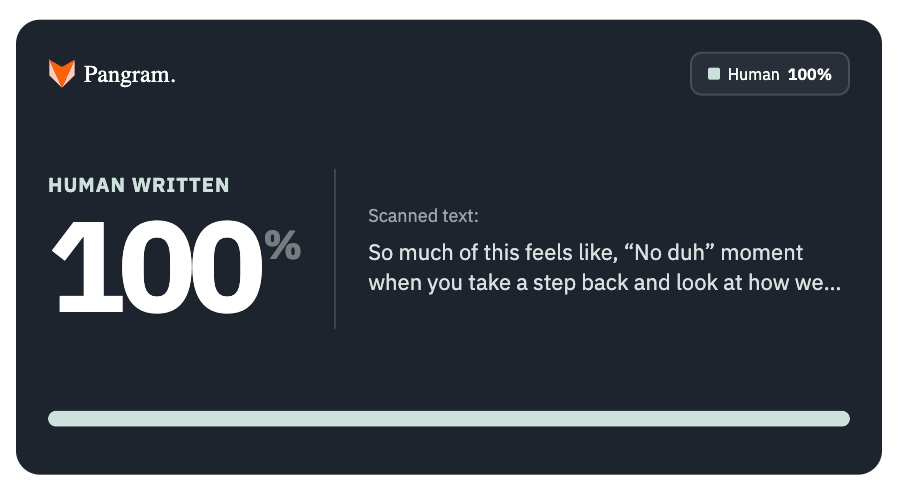
Take this paragraph, for example. Here’s the original version from the rough draft and how Pangram scores it.
So much of this feels like, “No duh” moment when you take a step back and look at how we got here. Silicon Valley gobbled up copyrighted work by the terabyte to train their machines. No one should be surprised that anything those machines touch is now in a murky grey legal void.
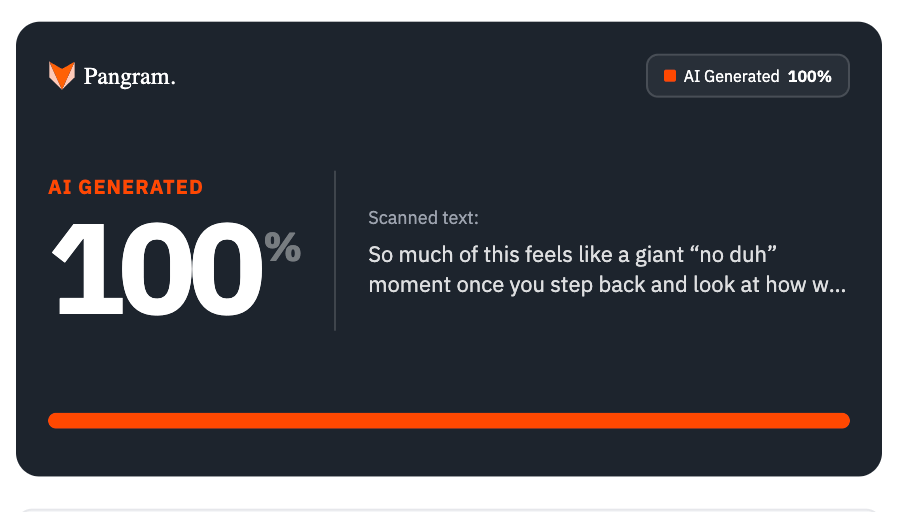
And here is what it became after ChatGPT took a pass, then I added my final finishing tweaks:
So much of this feels like a giant “no duh” moment once you step back and look at how we got here. Silicon Valley gobbled up copyrighted work by the terabyte to train these machines. We shouldn’t be particularly surprised that the legal status of whatever the machine churns out ends up in a murky gray swamp.
The first time I noticed this tendency with Pangram V.4, I spent about two hours rewriting one completely human-written section just to get the damn machine to recognize it as 100% human. Eventually, I gave up and had an AI make the section 100% human for me.
Which pretty much entirely defeats the purpose of the AI detector.
If everyone has access to the same generative models, people assume everyone is using them. We start believing everything we see is generated.
If everyone has access to the same AI detector, we’ll just assume everyone is using it to game the results.
Nothing changes.
We’re already getting an entire reactive industry built around this absurdity. AI number one generates the slop. AI number two detects the slop. AI number three “humanizes” the slop of AI number one, defeating AI number two. I tested this myself by having ChatGPT generate an intentionally obnoxious AI paragraph, then ran that paragraph through Undetectable.AI. Pangram subsequently scored the resulting machine-generated rewrite as 100% human.
Which brings us to the closest thing we have to an actual solution: Anthropic recently announced that Claude-generated text will include an imperceptible watermark. Unlike Pangram, a genuine text watermark could provide something more concrete than examining prose and asking, “Does this look statistically AI-ish?” For the first time, we may actually have something approaching forensic evidence of AI involvement.
A lot of people are understandably hailing watermarking as a solution. I’m less convinced, mainly because I played video games and grew up with The Pirate Bay.
The history of DRM is basically an endless cycle of companies inventing increasingly sophisticated locks and then the internet shouting, “Oh! Puzzle!” and immediately cracking them open. Hitman 2 shipped with a new version of Denuvo in 2018, and pirates cracked it so quickly that the crack was available before the game was officially released. Make that make sense.
Maybe Anthropic has built something remarkably resilient, but somebody will make removing that watermark their weekend project the second widespread detection tools exist. There’s money to be made from defeating it, so every company currently advertising an AI “humanizer” will eventually start boasting that it can scrub watermarks too.
Even with the EU pushing AI companies toward transparency measures like watermarking, not every model on Earth is going to cooperate. Open-weight and uncensored models will always operate outside compliant commercial systems, and I highly doubt Elon Musk will allow his Anti-Woke Freedom Bot to start narking on itself.
But watermarking still has one enormous benefit. If it works well enough to catch the laziest copy-pasted machine sludge, it may remove enough garbage from consideration to lower the ambient paranoia. A publisher confronted with a suspicious manuscript could at least check whether it contains a known watermark instead of asking Pangram for some literary palm reading.
When I take a step back, though, I have to ask: What the hell are we even doing? Why are we demanding that writing, a medium already seen as archaic by generations growing up with chronic TikTok brainrot, remain some pure, organic artisanal craft? It’s not a competitive sport. We’re just telling a freakin’ story.
Jerry Falade should be able to ask an AI to look up the effects of decomposition and bloating on a corpse without planting the seeds of his downfall. Authors should be able to use AI without treating any contact with it as disqualifying, as long as they’re honest about what it actually contributed. Prohibition never works. It only turns normal people into liars and frauds, which makes the actual liars and frauds feel right at home.
AI use in writing needs to be graded on a spectrum, not a binary. AI disclosure needs to become a surmountable penalty, not an immediate disqualification. Basically, we need to get to a place where AI-assisted work can be judged on its quality, because we’re never going to stop having mystery meat to contend with. That doesn’t mean we can’t still whip out the Grade-F stamp for the fully generated slop.
It just means we have to consider using grades A-D for mystery meat.
Thanks for reading! Subscribe for free to receive new posts and support my work.