

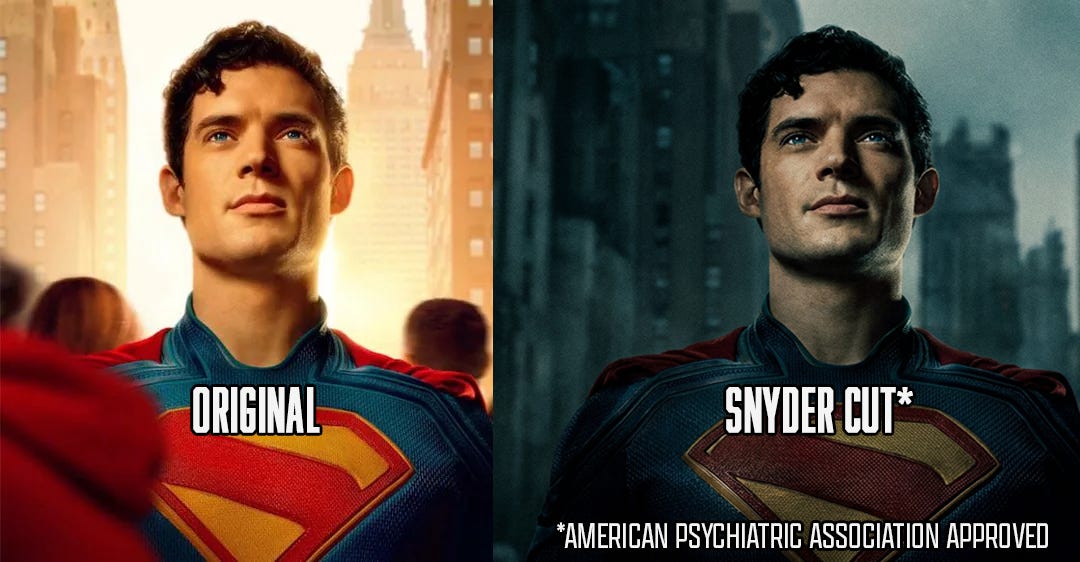
For years, Zack Snyder fans have perplexed clinical psychologists, displaying traits that went beyond their peculiar taste in movies yet stubbornly refused to fit within existing diagnostic criteria.
“I noticed something was wrong during Barbenheimer,” said 29-year-old Snyder fan Mike Allen. “I saw Oppenheimer first, loved it, then watched Barbie and wanted to gouge my eyes out. I ran out of the theater and spent the rest of the weekend watching Justice League on repeat, rocking back and forth. I thought something was wrong with me.”
“My colleagues and I kept coming across patients we couldn’t explain,” said psychiatrist Dr. Elaine Cho. “It was like they had autism, if autism dressed like Guy Fieri, and ADHD, if ADHD were narrated by Werner Herzog.”
After a decade of research, the American Psychiatric Association announced Friday that Snyder fans will finally receive their own diagnostic category in the DSM: Snyder Processing Disorder, or SPD.
The defining breakthrough came when researchers studied the intense online backlash to James Gunn’s Superman.
“Here we had the same hero presented in two vastly different ways,” Cho explained. “The Snyder-fan reaction was so uniformly negative that we realized we had stumbled onto Zack Snyder’s complete antithesis.”
Patients are now diagnosed with SPD by placing them along the Gunn-Snyder Spectrum, with more severe cases clustering almost entirely at the Snyder end.
By far, SPD’s most recognizable sensory trait is difficulty processing action presented at conventional speed.
“Much like dyslexic people were wrongly assumed to be slow readers, Snyder fans have been similarly dismissed,” Cho explained. “We’ve found that those with SPD struggle to process fast visual events in real time. A neurotypical viewer sees a punch occur in half a second and understands what happened. An SPD viewer needs at least nine seconds of slow-motion movement to truly absorb cause and effect.”
Auditory testing revealed a similar pattern.
“It’s like the movie is pulling my eyeballs one way and the soundtrack is pulling my ears in the complete opposite direction,” said SPD patient Kyle Branson, abruptly turning off Guardians of the Galaxy.
“Unlike patients whose sensory issues involve volume or intensity, people with SPD are perfectly comfortable with loud noises,” Cho explained. “Distorted guitars, pounding drums, an Icelandic woman wailing over an explosion—they love all of that. What they struggle with is recognizable lyrics.”
In one experiment, a subject became agitated while watching an Aquaman fight scene set to Dolly Parton’s “9 to 5.”
“He kept demanding to know whether he was supposed to listen to the song or watch the movie,” said visual-processing researcher Dr. Marcus Bell.
The same subject was later shown altered footage of Captain America lifting a concrete slab set to “God Dragging a Refrigerator Across Heaven (Epic Mix)” from the Sucker Punch soundtrack and immediately relaxed.
Another sensory component of SPD appears to be heightened chromatic sensitivity, with patients consistently preferring the muted grays, blues, and browns generally found on a 4K television contemplating suicide. Conversely, saturated colors tended to produce feelings of overstimulation, confusion, and complaints that a film “looks like fucking Marvel.”
“The average person sees Superman’s bright red cape and thinks, ‘Superman,’” Bell explained. “A Snyder-processing brain thinks, ‘Why is Superman screaming at me?’”
One of SPD’s defining traits appears to be a cognitive preference for clearly established roles and strict tonal consistency. Heroes should behave heroically. Villains should act like villains.
“Neurotypical audiences tend to view characterization as flexible,” Cho continued. “A grim character can occasionally be lighthearted. A comedic character can have tragic moments. That’s not the case with SPD.”
Comedic elements, in particular, are only acceptable when safely quarantined inside a comedy.
“In the same way My Little Pony became unexpectedly popular among autistic audiences, the Venn diagram between Zack Snyder fans and Dane Cook fans appears to be almost a perfect circle,” Cho explained. “They feel safe laughing because they know he’s not suddenly going to get serious or say anything of substance.”
“Dude, I love Step Brothers,” Branson said when asked about his favorite comedy. “Everybody in that movie is funny because they know it’s a funny movie. But Deadpool? God, that guy is annoying.”
Branson became visibly uncomfortable when researchers asked whether Batman could make a joke.
“What? No! No way! God, no!”
When asked why, Branson stared silently at the wall.
“Because he’s Batman. Batman is Batman because his parents died. You don’t joke after that. Ever.”
Branson began banging rhythmically on the table.
“Never-ever-ever-ever-ever-ever-ever-ever-ever.”
“Shoot, he’s stimming,” Cho said.
The session was cut short, and Matt Reeves’s The Batman was put on to calm Branson down.
Researchers say this rigid categorical thinking may finally explain why one of the most mocked scenes in Snyder’s filmography consistently resonates with his most devoted fans.
“In Batman v Superman, Batman abandons his murderous vendetta against Superman after learning that Superman’s mother is also named Martha,” Cho explained. “For years, viewers dismissed the moment as contrived, but we believe it may actually represent an unusually efficient form of SPD categorical cognition.”
“By a Snyder fan’s reasoning, Batman has Superman filed under ‘ALIEN.’ Aliens are ‘NOT HUMAN,’ and anything not human is automatically filed under ‘THREAT.’”
Cho gestured to two flowcharts, one representing neurotypical thought processes and the other those of people with SPD.
“When Superman tells Batman, ‘Save Martha,’ a neurotypical brain immediately starts spiraling. They think, ‘What? Who calls their mother by her first name? A normal person would say, “Save my mom.” Oh my God, I’ve been watching this conflict for two hours and its entire resolution hinges on the fact that Superman’s mom is named Martha? What if his mom were named Jane? Would Batman just kill Superman right there? In what world does that make sense?’”
Cho moved her finger down the SPD flowchart.
“But in a Snyder-processing brain, the shared name becomes a revelation that creates an empathic bridge. Through Batman’s POV, they see the logic as: ‘My mom is named Martha. Superman’s mother is named Martha. And if I’m a good guy and my mother is named Martha, then Superman must be a good guy too because his mother is also named Martha. We should be friends.’”
Cho nodded.
“For an SPD viewer, that’s not lazy writing. That’s an extremely satisfying database update.”
The addition of SPD to the Diagnostic and Statistical Manual of Mental Disorders has prompted major streaming services to begin testing Snyder Cuts as an accessibility feature alongside subtitles, audio description, and sign-language interpretation. When activated, the Snyder Cut automatically desaturates the image, slows significant action moments, removes disruptive humor, and replaces any lyrical songs with Evanescence.
So far, the results have been promising.
“So many of the people we thought were toxic fans were just unrepresented SPD viewers,” said James Gunn. “Now that they’re able to watch the Snyder Cut of Supergirl, they’re actually going back and updating their reviews.”

The technology could eventually make thousands of films far more accessible to SPD audiences. After his traumatic Barbenheimer experience, Mike Allen watched the Snyder Cut of Barbie, which replaces most of the pink with gunmetal gray and replaces every musical number with Mongolian throat singing, and was relieved to find the film “finally watchable.”
“And you know what?” Allen said, considering the film. “I think… I think I finally understand feminism now.”
Male viewers of the Snyder Cut of Obsession also reported dramatic improvements in comprehension thanks to additional footage designed to eliminate any moral ambiguity.
“The first time I watched Obsession, I came away thinking Bear was just kind of a pitiful dude trapped in this really crazy situation. I actually thought the wish was the whole problem,” said 31-year-old SPD patient Darren Cole. “Then I watched the Snyder Cut, and the moment he makes the wish, the movie stops completely so the director can look straight into the camera and say, ‘Bear is a bad guy and a rapist.’”
Cole sighed in relief.
“Man, it made all the difference. All the women in my office have finally started talking to me again.”
The addition of Snyder Processing Disorder has prompted researchers to investigate whether other intense fandoms may represent previously unrecognized neurocognitive profiles.
Wes Anderson Syndrome is increasingly looking like a condition previously thought to be obsessive-compulsive disorder, only pastel and at a weird aspect ratio.
Several institutes are also investigating Cronenbergitus, a condition in which patients struggle to express technological anxiety, sexual repression, or existential dread unless it grows teeth and emerges from their abdomen.
Lynchian Emotional Disorder is the most likely contender for official DSM recognition and is defined as a condition in which patients experience distress if reality fails to operate on dream logic. Early trials have found that patients are vastly more comfortable in social situations set to off-key Muzak and show significant improvement when an emotional-support midget is allowed to silently dance in the corner of the room.
Stop! 🤣 The milk is coming out my nose.