

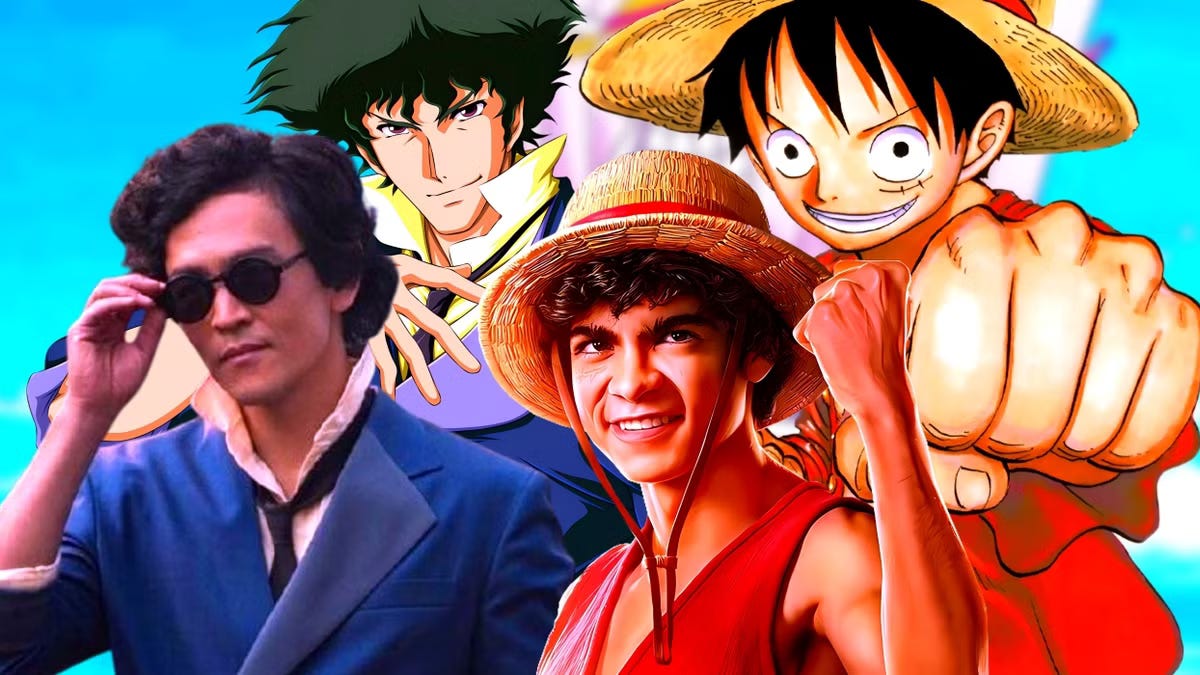
I’ve come to fear the words “Netflix Adaptation.”
It so often results in an end product dumped unceremoniously onto the platform. Their shows often feel cheap and uneven, with front-loaded VFX designed to trick you into thinking the budget won’t fall off a cliff by episode two. Even if the series manages to be worth your time, don’t ever get too attached. Cancellation always hangs over it like the sword of Damocles on a hair trigger. And if it does get renewed? Enjoy your 2–3 year wait while the cast visibly ages between episodes.
Of the many reasons Netflix has left me bitter (and there are many), none stings more than Cowboy Bebop. Seeing the Bebop in live-action has always been a long-time dream of mine, but the end result actually left me begging the streamer to take that dream behind the woodshed and put it out of its misery.
The adaptation attempt carried the usual Netflix work ethos of “We know half the audience will be on their phones, just aim for par,” but fell far short of even that. There was no distinct vision behind its creation, leaving it feeling like a fan-made short film stretched into 10 episodes, too timid to carry a vision beyond “do the anime, but live action.” Overall, so much of the series felt like Cosplay, not Cowboy Bebop. It's no surprise that the director of the original anime, Shinichiro Watanabe, said he turned the show off after the first ten minutes. I wish I had that kind of self-respect.
All of which is to say: watching One Piece stroll into its second season with confidence, ease, and style… stings. A lot.
When the two adaptations are compared, a lot of people have come to the conclusion that the live-action One Piece series is what you get when you have people who respect the source material, unlike the heathens who slopped out Cowboy Bebop, but that couldn’t be further from the truth.
Somehow, the same team that face-planted Cowboy Bebop came back and knocked One Piece out of the park using basically the same pipeline.
There’s also some extra irony to the Executive Producer of Cowboy Bebop and One Piece, Marty Adelstein, admitting,
“What we learned is the fans are expecting you to be true to the source material. As we read the comments [in response to Cowboy Bebop], it was always, ‘Well, they didn’t do this character the same as this and that’—It really taught us a lot of what we needed to do with this one.”
They clearly walked away learning the exact wrong message from making Bebop, but it was the exact right lesson they needed to make One Piece. Both adaptations take liberties with the source material. They both try to imitate the anime's look. Yet, One Piece works where Cowboy Bebop fails.
So what exactly happened?
After some deep, existential soul-searching and a bottle of whiskey, I landed on an answer:
There’s a paradox at the heart of adapting anime into live-action.
Anime isn’t just a medium. It’s also a genre. And those two things are tangled together in ways that make adaptation uniquely painful.
As a medium, anime isn’t constrained by reality. They don’t have to worry about the feasibility of a shoot location or the price tag of special effects. An anime set on an alien planet could cost just as much as an anime set in high school, where the live-action equivalents would effectively have you comparing Degrassi to James Cameron’s Avatar 3.
But anime is also a genre with its own tropes and style. It can be cartoony, deadly serious, emotionally devastating, surreal, violent, and pornographic and has no issue flipping between modes on a dime. Not being constrained by reality allows its stories to be as outlandish and over-the-top as they want. Chainsaw Man is about a kid who can turn into a chainsaw demon. Hellsing features a holy war between Protestants, Catholics, and Nazi Vampires. Neon Genesis Evangelion starts with high schoolers piloting giant robots, then quickly turns into watching Hideaki Anno animate his own mental breakdown.
While you can perform surgery to swap out the animated heart of How to Train Your Dragon and get a perfectly functional shot-for-shot remake, many attempts at transplanting anime often turn into heart surgery with a complete overhaul of the vascular system as well. You often end up with something compromised, Frankensteined and held together by stitches. American remakes are whitewashed and wildly diverging from the source material. Japanese remakes try to honor the source material, but can only meet the anime’s scope with terrible CGI and rushed storytelling.
Apparently, the answer Tomorrow Studios and Netflix had to this problem was simple: Don’t make it a movie. Leave the genre alone and just make it a live-action anime series instead. Duh.
That actually makes sense for something like One Piece, since the source material is an anime through and through. Its story is ridiculous. Its characters are doubly ridiculous. There is no way in hell you could ever ground it in realism and have it feel like a One Piece adaptation, so they didn’t even try. The end result looks like the bastard child of Pirates of the Caribbean and Lazytown.
And somehow it works. It works extremely well. For season 2, they just doubled down on the absurdity and guess what? It’s even better than season 1.
Fuck me, I guess.
So why did Cowboy Bebop fail?
Cowboy Bebop might be an anime, but it’s a major outlier more influenced by noir and spaghetti westerns than other anime. Its characters and its story are surprisingly grounded. There’s a subtlety to its world-building that leaves much to be inferred. When you strip away the animation of the original, you’re not going to find much anime inside its guts. Bebop is actually science fiction—good science fiction—that just so happened to be animated in Japan.
It’s why Netflix and Tomorrow Studios’ attempt to turn Cowboy Bebop into a live-action anime failed so spectacularly. They confused the original’s medium with its genre.
As counterintuitive as it sounds, straying further from the source material would have honored Cowboy Bebop more than creating a crude imitation. A real adaptation should’ve leaned into the sci-fi, hard. Spike, silently watching the smoke of a lit cigarette set to a crooning trumpet, feels more Spike than any space station kung-fu fight scene. A lazy smirk does more character building than any forced quip by John Cho. The end result should have been something closer to Firefly with the vibes of Blade Runner. A space western with jazz and room to breathe.
The muted colors and grit of The Expanse are a better fit than the oversaturated palette Netflix went with, which tried to ape the anime look.
A rotating set of clothing would have made the Bebop feel lived in. Instead, they stuck with their iconic looks, as if Spike wouldn’t be Spike if he didn’t cosplay like Spike. Jett’s angular facial hair only makes sense with the justification, “Well, it was that way in the anime.”
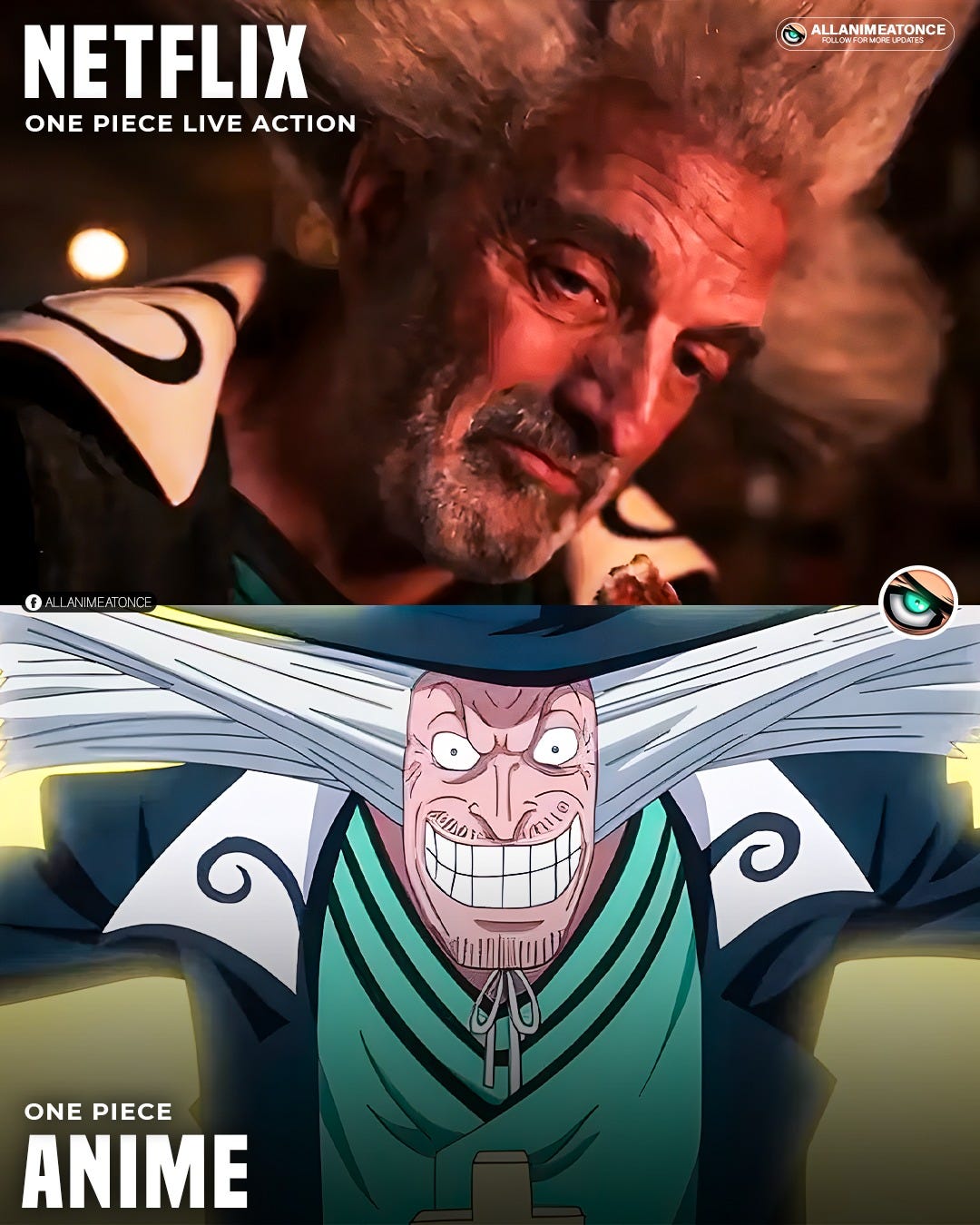
At the same time, One Piece Season 2 has a surprisingly emotional arc with Dr. Hiriluk, a character who rocks an insane anime-accurate tri-directional mohawk, and you don’t question it because it just fits the world they’re in.
Cowboy Bebop’s set design tried to match the anime’s junkyard retro-futuristic look, but offered no Sci-Fi worthy explanation for why you could find Cuban Resolver on Mars or have Jett standing on a Nixon-era suburban street in the very next scene. It often confused “this was an anime in the 90’s” with design choice, leaving you with a future full of CRT screens and analogue tapes. Worse, most of the retro was in the props and set design, while the set extensions carried all the futuristic sci-fi elements. You could clearly see where the physical set ended and the green screen began in almost every shot.
And then there’s Edward Wong Hau Pepelu Tivrusky IV.
When the live-action Radical Edward made a post-credit appearance in Cowboy Bebop to ham it up on-screen like some theater kid who forgot to take their Adderall, I reached such a low that I actually began to believe in God just so I could have someone to blame.
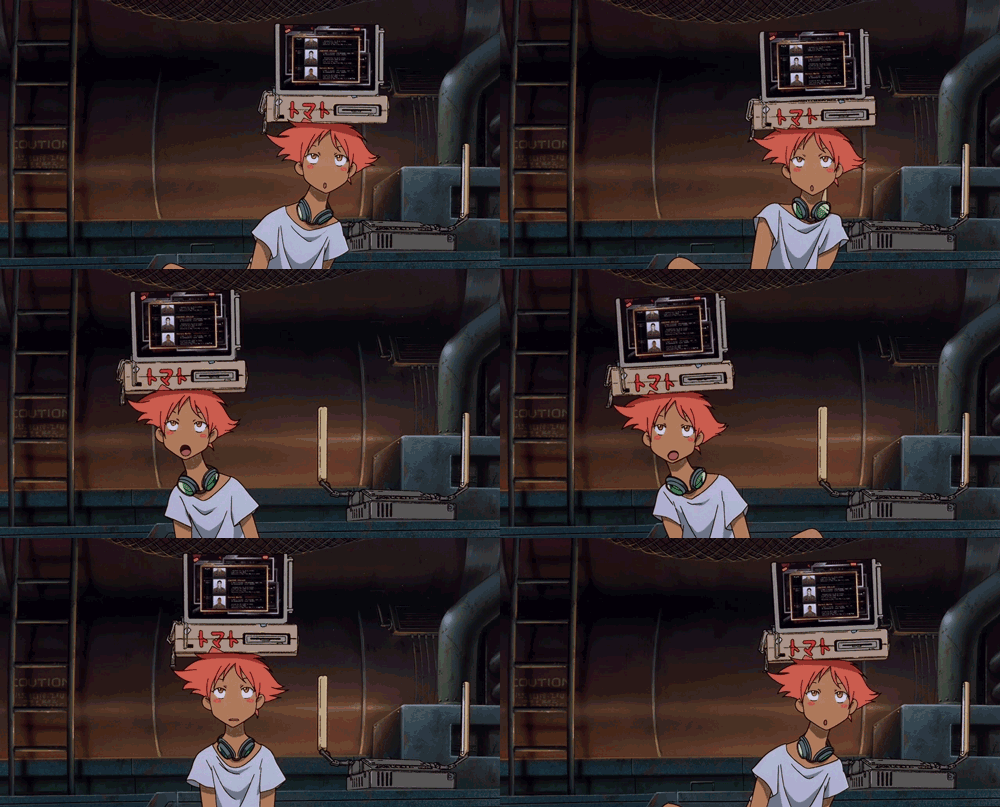
Ed is by far the most “anime” thing you will find in the original Cowboy Bebop. She’s over-the-top, silly, and the only character that uses those anime chibi expressions. When she isn’t contorted in a yoga pose so she can type with her feet, she’s usually delivering her lines by invading someone’s personal space or doing a handstand.
I always pictured Ed in live action form as a drastically toned-down version of that. She would still be an androgenous teen co-oping the Bebop’s main living area, but her anime quirks would be sanded off. Still on the spectrum with no concept of ‘awkward,’ but she certainly wouldn’t be bouncing off the walls.
When I saw her in the adaptation, I was convinced she was a panicked last-minute addition. That Netflix yoinked some girl from a local AnimeCon cosplaying as Ed and didn’t ask to see her resume. They just dragged her directly from the convention to the set.
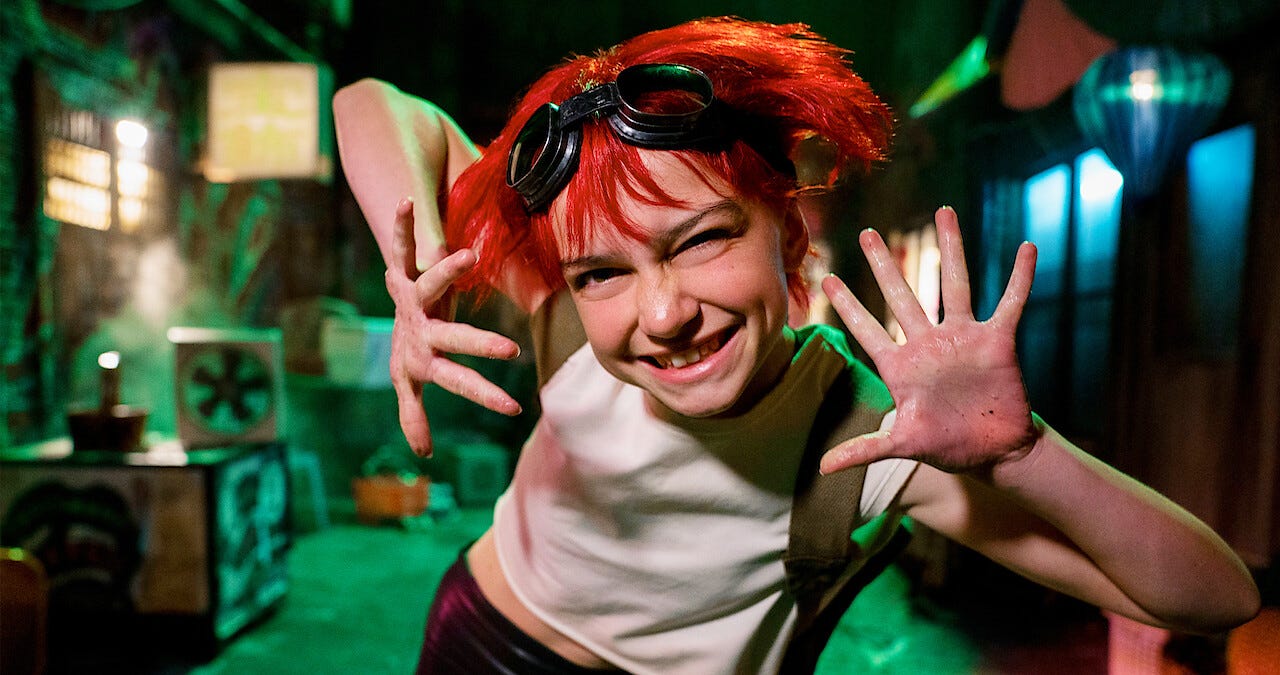
Now? Seeing Cowboy Bebop’s cringy final death spasm is almost educational, because everything about that scene, from the over-the-top performance to the hyper-faithful character design, is exactly what works in One Piece. That Ed would fit right into Monky D. Loofy’s crew, but not the Bebop’s.
Faithfulness isn’t about creating a 1:1 copy. It’s about understanding what needs to be preserved and what needs to change. It’s about providing added value to what was in the original, and sometimes that means going in a new direction. Stories like One Piece need translation. Others need transformation, and Cowboy Bebop was clearly in the latter category.
Sigh… maybe in ten years we can try again.
With HBO.
Please God, just make it HBO.
When they make a show like cow boy bee bop they make thease things called story boards. Theirs happened to be from a cartoon. Y'all would have complained if the clothes did not match.
In the future when Akira is made into live action,
I'm sure you will be disappointed again.
I watched the bee bop cartoons and then the live action. I did not have 20 years of fan boy want built up. The live action is the best show Netflix has ever made.
You fanboys screwed it up by complaining. There second season was to be all new material.